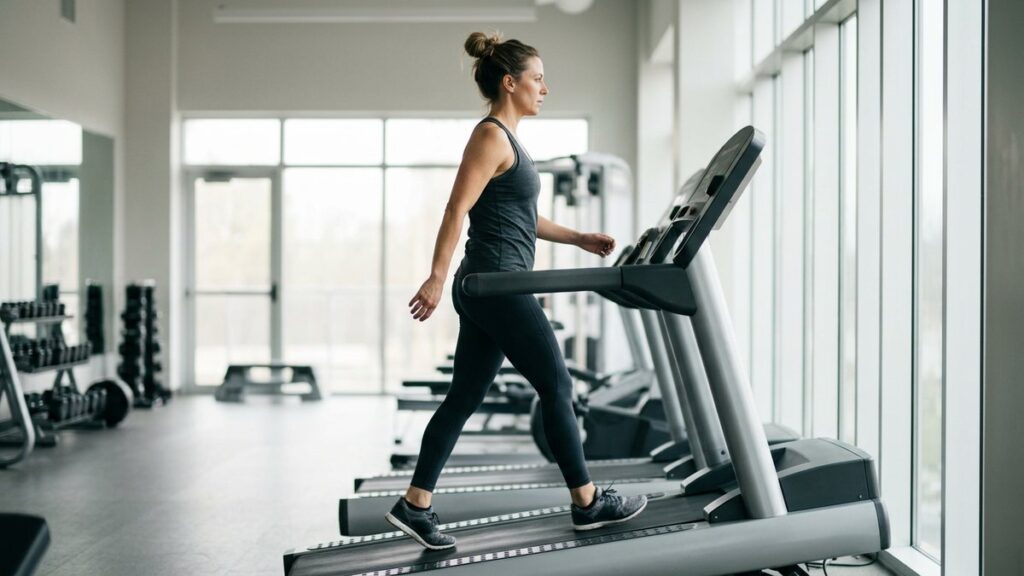
The 12-3-30 workout means walking on a treadmill at a 12% incline and 3 miles per hour for 30 minutes. Two lab studies measured an average burn of about 220 to 310 calories, and standard formulas estimate about two and a half times as many calories as flat walking at the same speed. It is solid, low-impact cardio, but running burns calories faster, and no study has tracked its long-term weight loss results.
Key takeaways
- In a 2025 lab study of 14 young adults, 12-3-30 burned about 308 calories in 30 minutes. Self-paced running burned the same amount in about 24 minutes.
- Incline walking drew a larger share of its energy from fat (41% vs. 33% for running), but total calories burned, not fuel mix, drive fat loss.
- Gripping the handrails can cut the oxygen you use, and so the calories you burn, by roughly 15% to 21%.
- Incline walking is lower impact than jogging, but it works your leg muscles harder than flat walking. Build up gradually.
- For weight loss, pair it with eating changes and strength training on at least two days a week.
What is the 12-3-30 workout?
The routine is exactly what the numbers say: set the treadmill to a 12% grade and 3 mph, then walk for 30 minutes. Social media creator Lauren Giraldo shared it on YouTube in 2019, and it later spread on TikTok. In her original video she said she holds the handrails about 30% of the time, according to researchers at the University of Nevada, Las Vegas (UNLV) who later tested the routine.
On flat ground, 3 mph is a brisk walk, which the Physical Activity Guidelines class as moderate intensity. The 12% incline is what makes it hard, because every step lifts your body uphill. That is why your heart rate climbs without the pounding of running.
How many calories does the 12-3-30 workout burn?
To estimate calories by body weight, we used the American College of Sports Medicine (ACSM) walking and running equations, which predict oxygen use from treadmill speed and grade.
The equations and the standard conversion factors are listed by the Compendium of Physical Activities: 1 mph equals 26.8 meters per minute, and each liter of oxygen equals about 5 calories. By this method, 12-3-30 works out to about 8.3 METs, or 8.3 times your resting energy use.
| Body weight | Flat walk, 3 mph | 12-3-30 (12%, 3 mph) | Run, 6 mph, flat |
|---|---|---|---|
| 130 lb | 102 | 256 | 315 |
| 150 lb | 118 | 295 | 364 |
| 170 lb | 133 | 334 | 412 |
| 190 lb | 149 | 374 | 461 |
| 210 lb | 165 | 413 | 510 |
| 230 lb | 181 | 452 | 558 |
| 250 lb | 196 | 492 | 607 |
Estimated calories for 30 minutes. These are gross figures, so they include the 30 to 60 calories your body would burn sitting still for the same half hour.
Treat the table as a ceiling, because real-world burns came in lower in both lab studies. UNLV measured an average of about 308 calories in people who averaged 166 pounds at enrollment, while the formula predicts 327. A study at Western Colorado University, commissioned by the American Council on Exercise (ACE), measured about 221 calories in people who averaged 148 pounds, against a formula estimate of about 290.
Leaning on the rails widens the gap. In treadmill tests, handrail support lowers the oxygen you use at a given speed and incline, so you burn fewer calories than the settings suggest.
12-3-30 results: what the research shows
The UNLV study: 12-3-30 vs. running
The UNLV team published what it describes as the first study to compare 12-3-30 directly with running, in the International Journal of Exercise Science in 2025. Sixteen recreationally active adults enrolled, with an average age of about 25, and 14 completed both sessions.
Each wore a face mask connected to a metabolic analyzer. They did 12-3-30 without holding the rails, then ran on a flat treadmill at their own pace until they had burned the same number of calories.
| Measure | 12-3-30 | Self-paced run |
|---|---|---|
| Time to finish | 30.1 minutes | 23.9 minutes |
| Calories burned | 308 | 310 |
| Calories per minute | 10.2 | 13.1 |
| Share of energy from fat | 40.6% | 33.1% |
| Share of energy from carbohydrate | 60.0% | 67.5% |
The authors explain that the higher fat share is expected, because 12-3-30 is less intense than running and the body burns relatively more fat at lower intensities. They stress that burning more energy overall, to create a calorie deficit, is the main driver of weight loss. The study was small, used young and active volunteers, and measured a single session, so it cannot show long-term results.
The ACE-supported study: intensity and enjoyment
In the ACE-supported study, 17 healthy adults who were not regularly active (average age 28) completed one 12-3-30 session. Their heart rates averaged 124 beats per minute, and the researchers classed the workout as moderate intensity, creeping toward vigorous late in the session.
Participants reported feeling good afterward, yet half of those who filled out an enjoyment survey agreed they would rather be doing something else. The study was published in the International Journal of Research in Exercise Physiology in 2024. ACE funded it, and like the UNLV study it was small and tested a single session.
Incline walking for weight loss: what it means
Five sessions a week add up to 150 minutes, the low end of the 150 to 300 weekly minutes of moderate activity in the Physical Activity Guidelines for Americans. The guidelines add that people who want to lose more than 5% of their body weight may need more than 300 minutes a week, and that combining calorie reduction with activity works better than either alone.
They also recommend muscle-strengthening activities on two or more days a week, which help preserve lean mass while you lose weight. For other options, compare our list of cardio exercises for weight loss.
Incline walking vs. running: which is better?
| Factor | 12-3-30 incline walk | Running |
|---|---|---|
| Calories per minute | Lower (10.2 in the UNLV study) | Higher (13.1) |
| Time to burn about 300 calories | About 30 minutes | About 24 minutes |
| Share of energy from fat | Higher | Lower |
| Impact on feet and joints | Lower | Higher |
| Fitness needed to start | Moderate, and you can lower the incline | Higher |
On impact, a 2025 study of 19 inactive young adults matched a steeper incline walk (20% grade) and flat jogging for calories burned. Jogging produced higher peak accelerations at the foot and the base of the spine and more muscle activity in the shin and front of the thigh. The authors called high-incline walking a lower-impact yet equally demanding alternative.
So the better choice depends on you. If your time is short and your joints are healthy, running or intervals burn more per minute, and the Physical Activity Guidelines call vigorous activity a time-efficient way to reach fitness and health goals. Our guide to HIIT workouts for weight loss covers that route.
If running hurts or you are new to exercise, incline walking is the easier habit to keep.
How to start the 12-3-30 treadmill workout safely
The full routine is hard for beginners. The federal guidelines advise inactive people to “start low and go slow,” and ACE’s write-up notes that older or less-fit people may need to work up to the full incline, speed and time. Here is a sample progression from our editorial team.
| Stage | Incline | Speed | Time | Move up when |
|---|---|---|---|---|
| 1 (weeks 1 to 2) | 3% to 5% | 2.5 to 3.0 mph | 15 to 20 min | You finish without holding the rails |
| 2 (weeks 3 to 4) | 6% to 8% | 3.0 mph | 20 to 25 min | You can still talk in short sentences |
| 3 (weeks 5 to 6) | 9% to 10% | 3.0 mph | 25 to 30 min | Your calves and knees feel fine the next day |
| 4 (week 7 on) | 11% to 12% | 3.0 mph | 30 min | You have reached 12-3-30 |
- Do three sessions a week at first, then build to four or five.
- Change one thing at a time: incline or minutes, not both in the same week.
- Repeat any stage for as long as you need. Moving slower beats getting hurt.
- Warm up for 3 to 5 minutes at a low incline and cool down the same way.
Form tips that protect the calorie burn
- Keep your hands off the rails. In a study of 10 healthy adults aged 38 to 60, gripping the handrails cut oxygen use by about 15% to 21% compared with swinging the arms freely at the same settings. Resting the hands lightly had a smaller effect, about 4% to 8%. If you need to hold on, lower the incline or speed instead.
- Stand tall. Lean slightly forward from the ankles, not the waist, and keep your chest open.
- Use a natural stride. Shorter, quicker steps are easier on a steep grade than long reaching ones.
- Swing your arms. It helps balance and rhythm.
- Wear supportive shoes and bring water. A steep half hour is real exercise.
- Plan for boredom. A podcast or playlist can help you stick with a routine that many people find repetitive.
Joint and back cautions
Incline walking is easier on the joints than running, and it may even ease one type of knee stress. In a Ball State University study of 12 healthy older men walking at 3 mph, a measure of load on the inner knee (the knee abduction moment) fell as the treadmill grade rose from 0% to 20%. The authors note that effects on other joints and directions of movement still need study.
Earlier research summarized by the UNLV team also shows that walking uphill makes the leg muscles work harder than walking on flat ground. Muscles and tendons need time to adapt, and the Physical Activity Guidelines advise increasing activity gradually over weeks to months to reduce injury risk.
- Knees and hips: If you have arthritis or knee pain, start at a lower incline and add grade slowly.
- Calves, ankles and Achilles: Uphill walking makes them work harder. Tightness or heel pain is a sign to drop the incline for a few days.
- Lower back: Hunching forward or hanging onto the rails shifts your posture. If your back aches, use a grade you can walk upright on.
The Physical Activity Guidelines advise adults with chronic conditions or symptoms to be under a health care provider’s care and to ask what activity suits them. That applies if you have heart disease, high blood pressure, diabetes, a recent injury or joint surgery, balance problems, or are pregnant.
Both lab studies excluded people with conditions like these, so their results may not apply. Stop and seek care if you feel chest pain, faintness or unusual shortness of breath.
Find more walking and cardio guides in our exercise and fitness section.
Frequently asked questions
Does the 12-3-30 workout burn belly fat?
Not directly. No workout targets fat in one area, and the UNLV authors note that an overall calorie deficit is the main driver of weight loss. If 12-3-30 helps you burn more energy than you eat, you will lose fat from all over your body, including your belly. Read more in our guide to whether walking burns belly fat.
Does the 12-3-30 workout build glutes?
It works your glutes, hamstrings and calves harder than flat walking, because every step lifts your body uphill. Research summarized by the UNLV team found more activity in the lower-body extensor muscles during incline walking than on flat ground. That builds endurance, but it does not replace strength training, which the Physical Activity Guidelines recommend on two or more days a week.
Can I do the 12-3-30 workout every day?
Many healthy people can, since 30 minutes a day fits within the activity guidelines. Your joints may do better if you alternate it with flat walking, cycling or strength days. Rest or scale back if your knees, calves or back feel sore.
Is 12-3-30 better than running for weight loss?
Running burns calories faster, about 24 minutes versus 30 for the same burn in the UNLV study. 12-3-30 is lower impact and easier to start. The best choice is the one you will do consistently while eating in a calorie deficit.
How long does it take to see 12-3-30 results?
No study has followed people doing 12-3-30 for weeks or months, so there is no evidence-based timeline. A clear early sign of progress is the same settings feeling easier. Weight change depends on your overall calorie balance, so pair the workout with eating changes.
Can I do 12-3-30 without a treadmill?
You can get a similar effect by walking up a steady hill or using stairs, though you cannot control the grade as precisely. On days at home, our list of the best exercises for weight loss at home offers treadmill-free options.
Sources
- An Exploratory Study Comparing the Metabolic Responses between the 12-3-30 Treadmill Workout and Self-Paced Treadmill Running, International Journal of Exercise Science (2025, via PubMed Central)
- The 12-3-30 Workout: ACE-supported Research Puts a Viral Workout to the Test, American Council on Exercise (2025)
- Physiological responses of the 12-3-30 workout: Exercise Myth or Reality, International Journal of Research in Exercise Physiology (Pelino, Diaz and Dalleck, 2024)
- Accelerations and EMG Differences Between Isocaloric High-Incline Walking and Level-Grade Jogging, International Journal of Exercise Science (2025, via PubMed Central)
- The effect of incline walking on lower extremity and trunk mechanics in older adults, Sports Medicine and Health Science (2025, via PubMed Central)
- The effect of handrail support on oxygen uptake during steady-state treadmill exercise, Journal of Cardiopulmonary Rehabilitation (2006)
- Unit Conversions, Compendium of Physical Activities
- Physical Activity Guidelines for Americans, 2nd edition, U.S. Department of Health and Human Services