A 1200 calorie meal plan can work for some smaller, less active women who want to lose weight, ideally with a doctor or dietitian involved. It is too little food for most men, teens, athletes and pregnant or breastfeeding women, and anyone with a history of eating disorders should not start one without their treatment team. The 7-day menu below averages 1,197 calories, 97 grams of protein and 31 grams of fiber a day and comes with a grocery list.
Key takeaways
- Obesity guidelines often set 1,200 to 1,500 calories a day for women who are losing weight. Treat 1,200 as a lower limit, not a starting point.
- Every day in our menu lands between 1,182 and 1,215 calories, with 93 to 101 grams of protein.
- Iron and vitamin D are the hardest nutrients to fit in. The week averages 12 mg of iron (women 19 to 50 need 18 mg) and about 220 IU of vitamin D (goal: 600 IU).
- Eat more and reassess if you lose more than 2 pounds a week after the first two weeks, feel shaky or dizzy, or miss a period.
Is 1,200 calories enough?
For most adults, no. Here is how it compares with maintenance estimates from the Dietary Guidelines for Americans, 2020–2025 (Appendix 2), based on a reference woman who is 5 feet 4 inches tall and weighs 126 pounds.
| Women’s age | Sedentary | Moderately active | Active | Daily gap at 1,200 (sedentary) |
|---|---|---|---|---|
| 19–25 | 2,000 | 2,200 | 2,400 | 800 calories |
| 26–30 | 1,800 | 2,000 | 2,400 | 600 calories |
| 31–50 | 1,800 | 2,000 | 2,200 | 600 calories |
| 51–60 | 1,600 | 1,800 | 2,200 | 400 calories |
| 61 and older | 1,600 | 1,800 | 2,000 | 400 calories |
Taller or heavier women burn more than the reference woman, so their gap at 1,200 calories is bigger.
The 2013 obesity guideline from the American Heart Association, the American College of Cardiology and The Obesity Society says weight-loss diets usually target 1,200 to 1,500 calories a day for women and 1,500 to 1,800 for men (Jensen et al., Circulation). Harvard Health puts the floor plainly: intake should not fall below 1,200 calories a day for women or 1,500 for men except under a health professional’s supervision (Harvard Health Publishing).
A 1200 calorie meal plan fits best for smaller, less active women. A sedentary woman over 50 burns about 1,600 calories a day, so a 1,500-calorie plan would leave her only a 100-calorie deficit. To find your own number, see our guide to how many calories you need to lose weight.
Who should not follow a 1,200-calorie diet
Skip this plan, or use it only with medical supervision, if:
- You are a man. Men usually need at least 1,500 calories a day to diet without supervision, so scale this plan up.
- You are under 18. The 2025–2030 Dietary Guidelines call adolescence a rapid growth period with higher needs for energy, protein, calcium and iron. The 2020–2025 calorie tables put girls ages 14 to 18 at 1,800 to 2,400 calories a day.
- You are pregnant. For women who start pregnancy at a healthy weight, estimated calorie needs rise by about 340 a day in the second trimester and 452 in the third (Dietary Guidelines 2020–2025, Table 5-2). Women with overweight or obesity should ask their provider for a target.
- You are breastfeeding. The same table adds 330 to 400 calories a day for making milk.
- You train hard most days. Active women need an estimated 2,000 to 2,400 calories a day just to maintain their weight.
- You have had an eating disorder. The National Institute of Mental Health notes that eating disorders are serious and can be life-threatening, and it names restrictive eating as one of their behaviors (NIMH). Talk with your treatment team first.
- You take insulin or diabetes pills that raise insulin, such as sulfonylureas or meglitinides. Eating too few carbohydrates or skipping or delaying meals can cause low blood glucose with these medicines (NIDDK), so your doses may need to change first.
- You have kidney disease or another chronic condition. The 2025–2030 Dietary Guidelines advise people with a chronic disease to ask their health care professional whether the guidelines need adapting. This plan is high in protein, so ask first.
The 7-day high-protein 1200 calorie meal plan
We built this 1200 calorie meal plan high in protein around three habits: protein at every meal, a vegetable or fruit at most meals, and three calcium-rich foods a day. We calculated every number from USDA FoodData Central (SR Legacy entries).
How we counted:
- Meat, fish, grains and beans are cooked weights.
- Eggs are cooked in a nonstick pan unless oil is listed.
- Water, black coffee, plain tea, herbs, spices, vinegar, lemon juice, garlic and ginger are not counted.
- Beans are unsalted and no salt is added, so your sodium will be higher; rinse canned beans.
- Hummus, salsa and tortillas vary by brand, so check labels.
| Day | Calories | Protein (g) | Fiber (g) |
|---|---|---|---|
| Day 1 | 1,201 | 100 | 30 |
| Day 2 | 1,197 | 93 | 32 |
| Day 3 | 1,201 | 97 | 31 |
| Day 4 | 1,192 | 94 | 33 |
| Day 5 | 1,193 | 101 | 29 |
| Day 6 | 1,182 | 96 | 35 |
| Day 7 | 1,215 | 101 | 29 |
| Daily average | 1,197 | 97 | 31 |
Meal and daily totals may differ by a calorie or two because of rounding.
Day 1
- Breakfast (240 calories, 22 g protein): 6 oz plain nonfat Greek yogurt with 1 cup raspberries and 1/4 cup rolled oats stirred in.
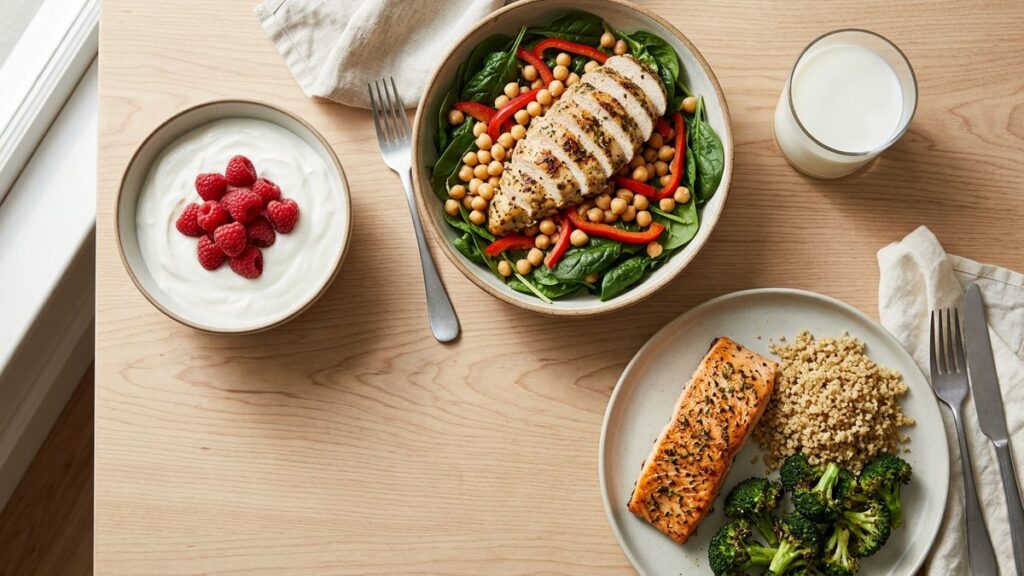
- Lunch (348 calories, 36 g protein): salad of 2 cups raw spinach, 3 oz roasted chicken breast, 1/2 cup chickpeas, 1/2 cup sliced red bell pepper and 1/2 cup cucumber, with 1 tsp olive oil and vinegar.
- Dinner (380 calories, 27 g protein): 3 oz baked salmon, 1 cup steamed broccoli and 1/2 cup cooked quinoa, with 1 tsp olive oil.
- Snack (233 calories, 16 g protein): 1 cup skim milk, 1 small apple and 1 oz part-skim mozzarella (about one string cheese stick).
Day 2
- Breakfast (327 calories, 23 g protein): 1/2 cup rolled oats cooked in 1 cup skim milk, topped with 1/2 cup blueberries and 3 oz plain nonfat Greek yogurt.
- Lunch (383 calories, 32 g protein): 1 large whole-wheat pita filled with 3 oz light tuna (canned in water, drained), 2 tbsp hummus, 1 cup romaine and 1/2 cup cucumber, with about 8 baby carrots (85 g) on the side.
- Dinner (426 calories, 37 g protein): turkey chili made with 2.5 oz cooked 93% lean ground turkey, 1/2 cup kidney beans, 1 cup canned tomatoes, 1/2 cup onion and 1/2 cup red bell pepper, topped with 1 oz shredded part-skim mozzarella.
- Snack (62 calories, 1 g protein): 1 medium orange.
Day 3
- Breakfast (322 calories, 27 g protein): 2 eggs scrambled with 1 cup spinach and 1/2 cup sliced mushrooms, 1 slice whole-wheat toast and 1 cup skim milk (or a skim latte).
- Lunch (385 calories, 19 g protein): bowl of 1/2 cup black beans, 1/2 cup brown rice, 1 cup romaine, 1/4 cup salsa, 1 oz shredded part-skim mozzarella and 2 tbsp mashed avocado.
- Dinner (331 calories, 32 g protein): 4 oz baked cod, 1 small baked potato with skin and 1 cup green beans, with 1 tsp olive oil.
- Snack (164 calories, 19 g protein): 6 oz plain nonfat Greek yogurt with 1 cup raspberries.
Day 4
- Breakfast (306 calories, 23 g protein): 1/2 cup 1% cottage cheese with 1 cup strawberries, plus 1 slice whole-wheat toast with 1 tbsp peanut butter.
- Lunch (340 calories, 33 g protein): lentil salad of 3/4 cup cooked lentils, 2 oz chicken breast, 1 cup spinach, 1/2 cup cucumber and 1/2 cup chopped red bell pepper, with 1 tsp olive oil and lemon juice.
- Dinner (420 calories, 30 g protein): stir-fry of 1/2 cup firm tofu (made with calcium sulfate), 1 cup broccoli, 1/2 cup sliced red bell pepper and 1/2 cup mushrooms in 1 tsp oil with garlic and ginger, over 1/2 cup brown rice.
- Snack (125 calories, 9 g protein): 1 cup skim milk and 1 kiwi.
Day 5
- Breakfast (321 calories, 24 g protein): 6 oz plain nonfat Greek yogurt with 1 cup raspberries, 1/4 cup rolled oats and 1/2 oz almonds (about 11).
- Lunch (413 calories, 33 g protein): 1 large whole-wheat pita with 2.5 oz chicken breast, 2 tbsp hummus, 1 cup romaine, 1/2 cup cucumber and 1/2 cup sliced red bell pepper, with about 8 baby carrots.
- Dinner (304 calories, 29 g protein): 3 oz roast pork tenderloin, 1 medium baked sweet potato and 1 cup asparagus, with 1 tsp olive oil.
- Snack (155 calories, 15 g protein): 1 cup skim milk and 1 oz part-skim mozzarella.
Day 6
- Breakfast (326 calories, 20 g protein): 2 breakfast tacos with 2 scrambled eggs, two 6-inch corn tortillas, 1/4 cup black beans and 2 tbsp salsa.
- Lunch (304 calories, 23 g protein): lentil soup of 3/4 cup cooked lentils simmered with 1/2 cup canned tomatoes, 1/4 cup onion, 5 baby carrots and 1 cup spinach, topped with 1 oz shredded part-skim mozzarella.
- Dinner (357 calories, 35 g protein): 3 oz chicken breast with 3/4 cup whole-wheat spaghetti, 1 cup zucchini and 1/2 cup canned tomatoes, with 1 tsp olive oil.
- Snack (195 calories, 18 g protein): 1 cup skim milk, 1 medium orange and 3 oz plain nonfat Greek yogurt.
Day 7
- Breakfast (383 calories, 18 g protein): 1/2 cup rolled oats cooked in 1 cup skim milk, with 1 tbsp peanut butter and 1/2 medium banana.
- Lunch (309 calories, 31 g protein): salad of 3 oz light tuna, 1/2 cup chickpeas, 2 cups romaine, 1/2 cup cucumber and 1/2 cup sliced red bell pepper, with 1 tsp olive oil and lemon juice.
- Dinner (381 calories, 34 g protein): fajita bowl of 2 oz chicken breast, 1/2 cup red bell pepper and 1/2 cup onion cooked in 1 tsp oil, 1/2 cup black beans, 2 tbsp salsa and 1 oz shredded part-skim mozzarella.
- Snack (142 calories, 18 g protein): 6 oz plain nonfat Greek yogurt and 1 kiwi.
Grocery list for the week
Amounts are summed from all 7 days. Meat and fish lose about a quarter of their weight in cooking, so buy roughly 4 oz raw for every 3 oz cooked.
To save time, cook the chicken on day 1 and again on day 4, the brown rice on day 3 and the lentils on day 4, so nothing cooked sits in the fridge more than 3 days. Freeze raw chicken or fish you won’t cook soon, and thaw it in the fridge overnight.
- Proteins and dairy
- Chicken breast: 12.5 oz cooked (buy about 1 pound raw)
- Plain nonfat Greek yogurt: 30 oz
- Skim milk: 7 cups
- Part-skim mozzarella: 6 oz
- Light tuna in water: 6 oz drained
- Raw cod about 5.5 oz, salmon 4 oz, pork tenderloin 4 oz and 93% lean ground turkey 3.5 oz (4, 3, 3 and 2.5 oz cooked)
- Eggs: 4
- Calcium-set firm tofu and 1% cottage cheese: 1/2 cup each
- Produce
- Raspberries 3 cups, strawberries 1 cup and blueberries 1/2 cup
- 2 oranges, 2 kiwis, 1 small apple and 1 banana
- Spinach and romaine: 5 cups each
- Red bell pepper: 3 1/2 cups (3 to 4 peppers)
- Cucumber: 2 1/2 cups sliced (about 1 large)
- Baby carrots: about 21
- Broccoli 2 cups; mushrooms, green beans, asparagus and zucchini 1 cup each
- Onion: 1 1/4 cups chopped (about 2 medium)
- 1 small potato, 1 medium sweet potato and 1 small avocado
- Lemon, garlic and fresh ginger
- Grains and beans
- Rolled oats: 1 1/2 cups dry
- Cooked lentils 1 1/2 cups, black beans 1 1/4 cups, chickpeas 1 cup and kidney beans 1/2 cup
- Cooked brown rice 1 cup, quinoa 1/2 cup and whole-wheat spaghetti 3/4 cup
- 2 large whole-wheat pitas, 2 slices whole-wheat bread and two 6-inch corn tortillas
- Pantry
- Canned tomatoes: 2 cups
- Olive or other cooking oil: 3 tbsp
- Salsa 1/2 cup, hummus 4 tbsp, peanut butter 2 tbsp and almonds 1/2 oz
- Vinegar, herbs and spices
Build your own 1,200-calorie day
To swap meals, keep each one near these targets, with at least one vegetable or fruit, or pick from our low-calorie meals.
| Meal | Calories | Protein | Build it from | Menu example |
|---|---|---|---|---|
| Breakfast | About 300 | 20–25 g | Dairy or eggs, a fruit and a small whole grain | Day 2 oats |
| Lunch | About 350 | 25–35 g | 2–3 oz lean protein or 3/4 cup lentils, 2 cups vegetables, beans or a grain | Day 1 chicken salad |
| Dinner | About 400 | 25–35 g | 3–4 oz fish, poultry, pork or tofu, 1 cup vegetables, a starch and 1 tsp oil | Day 6 chicken spaghetti |
| Snack | About 150 | 15–20 g | A dairy food and a fruit | Day 7 yogurt and kiwi |
Vegetarian swap: replace chicken, fish, turkey or pork with the same amount of protein from tofu, lentils, eggs or extra Greek yogurt.
How to make a 1,200-calorie meal plan high in protein
Put a lean protein such as Greek yogurt, cottage cheese, chicken, fish, tofu, beans or lentils at every meal. That is how this week averages 97 grams of protein, about a third of its calories.
The 2025–2030 Dietary Guidelines set a protein goal of 1.2 to 1.6 grams per kilogram of body weight a day, adjusted for calorie needs. That makes 97 grams a fit for people who weigh roughly 134 to 178 pounds.
If you weigh less, trim the chicken or fish by an ounce and add a piece of fruit. For more ideas, see our guides to protein intake for fat loss and low-calorie, high-protein foods.
Nutrient gaps to watch at 1,200 calories
Fewer calories leave less room for vitamins and minerals. Here is how the week compares with the nutrient goals in the Dietary Guidelines’ Appendix 1.
| Nutrient | Sample week: average (range) | Goal, women 19–50 | Goal, women 51+ | How the week does |
|---|---|---|---|---|
| Fiber | 31 g (29–35) | 25–28 g | 22 g | Meets every day |
| Calcium | 1,051 mg (921–1,485) | 1,000 mg | 1,200 mg | Meets on average under 51 (4 days fall 27 to 79 mg short); short on 6 of 7 days at 51+ |
| Iron | 12.1 mg (10.1–14.6) | 18 mg | 8 mg | Short every day for women 19–50; meets at 51+ |
| Vitamin D | About 220 IU (about 120–570) | 600 IU | 600 IU (800 IU after 70) | Short every day |
- Calcium: in USDA data, 1 cup of skim milk has about 299 mg, 6 oz of nonfat Greek yogurt about 187 mg, 1 oz of part-skim mozzarella about 222 mg, and 1/2 cup of calcium-set firm tofu about 861 mg. Women over 50 need a fourth calcium-rich serving most days, such as 1 cup of skim milk (83 calories), so trim a grain or fat elsewhere.
- Iron: even with beans, lentils, spinach, tofu and lean meat, the week falls short for women who menstruate. An iron-fortified cereal can help; ask your doctor about an iron test before you take a supplement.
- Vitamin D: few foods supply much; salmon, eggs and fortified milk supplied most of it here. Ask your doctor whether you need a supplement.
Signs your intake is too low
A 1,200-calorie plan should leave you a little hungry before meals, not drained. Add 100 to 200 calories a day and reassess if you notice:
- Fast weight loss after the first two weeks. Harvard Health calls 1 to 2 pounds a week a rate experts consider safe. NIDDK warns that losing weight too quickly may cause health problems and that rapid loss on very low-calorie diets raises gallstone risk (NIDDK).
- Shaky, dizzy, confused or racing-heart spells, especially if you take diabetes medicine. NIDDK lists these as symptoms of low blood glucose, so check your blood sugar and call your care team.
- Constant hunger, bingeing or growing fear around food. Stop the plan and talk to a doctor.
- A missed period, dizziness when you stand up, or fainting. Stop the plan and see a doctor.
Easy 100-calorie add-ons: 1 cup skim milk (83 calories), 1 tbsp peanut butter (96) or a medium banana (105).
Judge progress by the two-week trend, not single weigh-ins. If you are losing 1 to 2 pounds a week and feel fine, keep going.
Frequently asked questions
How much weight will I lose eating 1,200 calories a day?
It depends on how much you burn. Harvard Health says losing 1 to 2 pounds a week takes a daily deficit of about 500 to 1,000 calories, so a smaller deficit means slower loss. For example, a sedentary woman in her 40s who maintains on about 1,800 calories has a 600-calorie daily gap, which by that math is a little over 1 pound a week.
Why am I not losing weight on 1,200 calories?
Small extras add up. Weigh your food for a few days and count cooking oil and drinks, which are easy to miss. If you still see no loss after three to four weeks, add activity rather than going below 1,200 calories without medical supervision.
Can men follow a 1,200-calorie diet?
Not on their own. Harvard Health’s floor for men is 1,500 calories a day without supervision, and the obesity guideline’s usual target for men is 1,500 to 1,800. Scale this plan up with larger portions and snacks.
Do I need a multivitamin on 1,200 calories a day?
You might. Even our planned week fell short on iron for women under 51 and on vitamin D for everyone, so ask your doctor or dietitian to check your levels.
Can I exercise while eating 1,200 calories?
Yes. The obesity guideline pairs a lower-calorie diet with at least 150 minutes a week of activity such as brisk walking. If you train hard most days, though, 1,200 calories is likely too low.
Browse more structured plans in our diet plans section.
Sources
- 2013 AHA/ACC/TOS Guideline for the Management of Overweight and Obesity in Adults, Circulation (via PubMed Central)
- Calorie counting made easy, Harvard Health Publishing
- FoodData Central, US Department of Agriculture, Agricultural Research Service
- Dietary Guidelines for Americans, 2020–2025 (Appendix 1: Nutritional Goals; Appendix 2: Estimated Calorie Needs; Table 5-2), USDA and HHS
- Dietary Guidelines for Americans, 2025–2030, USDA and HHS
- Low Blood Glucose (Hypoglycemia), National Institute of Diabetes and Digestive and Kidney Diseases
- Eating, Diet, & Nutrition for Gallstones, National Institute of Diabetes and Digestive and Kidney Diseases
- Eating Disorders, National Institute of Mental Health