How much fiber per day do you need? Most adults need 22 to 34 grams, depending on age and sex, based on the Dietary Guidelines rule of 14 grams for every 1,000 calories you usually eat. To support weight loss, aim for about 25 to 30 grams a day, even while you cut calories.
Key takeaways
- The standard target is 14 grams of fiber per 1,000 calories, which works out to 22 to 34 grams a day for most adults.
- In a large diet trial, fiber intake was the strongest predictor of weight loss, and people who ate more fiber stuck to their diets better.
- A one-rule plan, “eat at least 30 grams of fiber a day,” led to weight loss close to that of a much more complex diet.
- Fibermaxxing works best slowly. Add a few grams at a time and drink more water to avoid gas, bloating and constipation.
- People with IBS, inflammatory bowel disease, gastroparesis or recent gut surgery may need a tailored plan.
How much fiber per day do you need?
The Dietary Guidelines for Americans, 2020–2025 set fiber goals at 14 grams per 1,000 calories, based on National Academies reference values linked to lower heart disease risk. Applied to typical calorie needs, that gives these daily targets:
| Age | Women | Men |
|---|---|---|
| 19 to 30 | 28 g | 34 g |
| 31 to 50 | 25 g | 31 g |
| 51 and older | 22 g | 28 g |
You may also see a range of 21 to 38 grams a day, as on MedlinePlus. Both ranges come from the same National Academies reference values. The Dietary Guidelines adjust them to typical calorie needs for each age group.
The 2020–2025 guidelines also report that more than 90% of women and 97% of men do not meet these goals. The main reason is simple: most adults eat too few fruits, vegetables and whole grains. On average, Americans eat only about 16 grams a day, MedlinePlus notes.
The newer Dietary Guidelines for Americans, 2025–2030 keep the same direction. They tell Americans to prioritize fiber-rich whole grains, aim for 3 servings of vegetables and 2 of fruit a day on a 2,000-calorie pattern, and note that high-fiber foods support a diverse gut microbiome.
Fiber targets by calorie level
If you know roughly how many calories you eat, multiply by 14 grams per 1,000 calories:
| Daily calories | Fiber at 14 g per 1,000 calories |
|---|---|
| 1,200 | about 17 g |
| 1,500 | about 21 g |
| 1,800 | about 25 g |
| 2,000 | 28 g |
| 2,400 | about 34 g |
Should you eat less fiber when you eat fewer calories?
No. On a 1,200-calorie diet, the formula gives only 17 grams, but treat that as a floor, not a goal. Fiber is one of the few things you want more of while dieting, because it helps meals fill you up for fewer calories.
Our advice is to aim for your age-and-sex target, or roughly 25 to 30 grams, while you lose weight. That matches the 30-gram goal used in the trial described below.
Soluble vs insoluble fiber
Soluble fiber turns to gel during digestion, which slows it down. It is found in oat bran, barley, nuts, seeds, beans, lentils, peas and some fruits and vegetables, and it can help lower cholesterol.
Insoluble fiber, found in wheat bran, whole grains and vegetables, adds bulk and helps food move through the gut. Most high-fiber foods contain both types, according to MedlinePlus, and both count toward your daily total.
Fiber and weight loss: what the research shows
Fiber is not a fat burner. It helps by making a calorie deficit easier to live with.
The strongest evidence comes from the POUNDS Lost trial analysis, published in the Journal of Nutrition in 2019. Researchers followed 345 adults with overweight or obesity who ate about 750 calories a day below their needs for 6 months. Average weight loss was about 16 pounds (7.3 kg).
Of all the factors in the researchers’ final model, fiber intake was the most influential predictor of weight loss, independent of calories and of the mix of carbs, fat and protein. Higher fiber intake was also strongly linked to sticking with the assigned diet.
Because this was an analysis of what people chose to eat, it shows a strong link rather than proof that fiber alone caused the loss.
A second study tested fiber as the whole plan. In a 12-month randomized trial in 240 adults with metabolic syndrome, one group got a single goal: eat at least 30 grams of fiber a day, with no calorie target. The other group followed the full American Heart Association diet, with calorie goals and about a dozen other rules.
The fiber group lost 4.6 pounds (2.1 kg) and the heart association group lost 6 pounds (2.7 kg). The difference was not statistically significant. The authors concluded that a simple fiber goal is a reasonable option for people who find complex diets hard to follow.
Why it works: high-fiber foods are bulky, take longer to chew and tend to have fewer calories per bite. Some soluble fibers, such as those in oats, beans and psyllium, form a gel that slows digestion. Both effects help you feel full on less.
Fibermaxxing: how to add fiber without the bloat
Fibermaxxing is a social media trend of loading meals with fiber, sometimes far past official targets. The goal of getting more fiber is a good one, since most people eat too little.
The risk is doing it overnight. A sudden jump can bring gas, bloating and cramps, MedlinePlus notes. Water helps fiber pass through your digestive system, so more fiber with too little to drink can backfire.
For people with IBS, the National Institute of Diabetes and Digestive and Kidney Diseases (NIDDK) suggests adding fiber slowly, by 2 to 3 grams a day, to help prevent gas and bloating. That pace, or slower, is a sensible default for anyone. A practical ramp:
- Find your baseline. Log a few typical days and total your fiber. Many people find they are well short of their target.
- Add one fiber food at a time. For example, swap white toast for oatmeal, then add a fruit at lunch a few days later.
- Hold for a few days after each step. If you feel gassy or bloated, stay at that level until it settles.
- Drink more as you go. Water, milk, tea and soups all count toward fluids.
- Stop at your target. The trial that tested a simple fiber goal used 30 grams a day. More is not automatically better.
15 high-fiber foods for weight loss
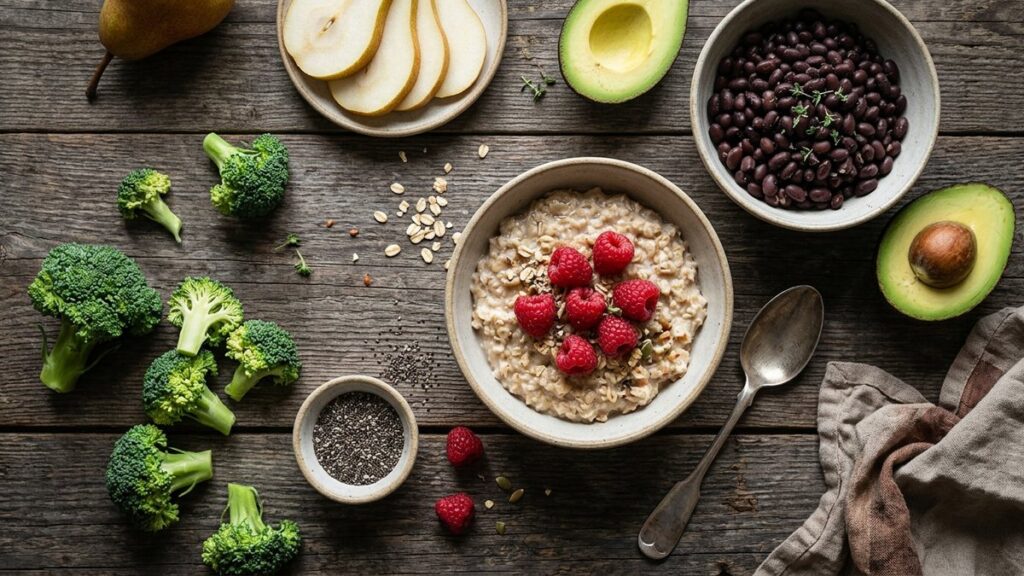
These values come from USDA FoodData Central (SR Legacy entries), rounded to one decimal. Beans and lentils stand out because they add protein too, which helps you stay full.
| Food | Serving | Fiber (g) | Calories |
|---|---|---|---|
| Chia seeds, dried | 1 oz (28 g) | 9.8 | 138 |
| Navy beans, cooked | 1/2 cup | 9.6 | 127 |
| Raspberries, raw | 1 cup | 8.0 | 64 |
| Lentils, cooked | 1/2 cup | 7.8 | 115 |
| Black beans, cooked | 1/2 cup | 7.5 | 114 |
| Chickpeas, cooked | 1/2 cup | 6.2 | 134 |
| Pear, raw | 1 medium | 5.5 | 101 |
| Broccoli, cooked | 1 cup, chopped | 5.1 | 55 |
| Avocado | 1/2 cup, cubed | 5.0 | 120 |
| Whole-wheat spaghetti, cooked | 1 cup | 4.6 | 174 |
| Apple, with skin | 1 medium | 4.4 | 95 |
| Oats, rolled, dry | 1/2 cup | 4.1 | 153 |
| Green peas, frozen, cooked | 1/2 cup | 3.6 | 62 |
| Almonds | 1 oz (about 23) | 3.5 | 164 |
| Popcorn, air-popped | 3 cups | 3.5 | 93 |
Fruit is an easy place to start. Per calorie, raspberries and pears carry far more fiber than bananas or grapes, according to the same USDA data, and our guide to the best fruit for weight loss compares more options. For a wider list beyond high-fiber picks, see our roundup of foods that help you lose weight.
A sample 30-gram fiber day
This plan uses foods from the table plus a few everyday extras. Fiber values come from the same USDA data.
| Meal | Foods | Fiber (g) |
|---|---|---|
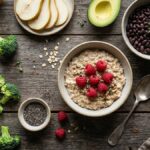
| Breakfast | 1/2 cup rolled oats cooked in water or milk, topped with 1/2 cup raspberries | 8.1 |
| Lunch | Salad with 1 cup spinach, 1 cup cherry tomatoes, 1/2 cup black beans and grilled chicken | 10.0 |
| Snack | 1 medium apple | 4.4 |
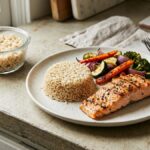
| Dinner | 1 cup whole-wheat spaghetti, 1/2 cup broccoli and baked salmon or chicken | 7.2 |
| Total | about 30 |
The fiber foods here add up to about 630 calories. Protein foods, dairy and a little oil fill out a typical 1,500- to 1,800-calorie weight-loss day.
If you like oats, our oatmeal drink guide shows a blended way to get the same fiber. Eating more plants overall makes 30 grams easier, as our guide to a plant-based diet for weight loss explains. Find more meal ideas in our healthy eating guides.
Do fiber supplements help with weight loss?
Possibly a little, but food is the better bet. A 2023 meta-analysis of six trials with 354 people found that psyllium, taken just before meals at about 10.8 grams a day for nearly 5 months, led to about 4.6 pounds (2.1 kg) more weight loss than control. The authors work for the company that makes Metamucil, and six small trials is a thin base, so treat that result with caution.
Supplements also miss what fiber-rich foods bring along: vitamins, minerals, protein and volume on the plate. If you use one, follow the label. MedlinePlus advises mixing psyllium powder with at least 8 ounces (240 mL) of liquid.
Tell your doctor first if you have trouble swallowing or have had an intestinal blockage. Do not take digoxin, aspirin or nitrofurantoin within 3 hours of psyllium. The FDA does not approve dietary supplements for safety or effectiveness before they are sold.
Who should be careful with high-fiber foods
- IBS: NIDDK notes that soluble fiber, from beans, fruit and oats, seems more helpful for IBS symptoms. Some high-fiber foods, including apples, pears and beans, are high in FODMAPs, carbohydrates that can trigger IBS symptoms. A dietitian can help you choose.
- Crohn’s disease or ulcerative colitis: ask your GI team before a big fiber increase, especially during a flare or if you have been told you have a narrowed bowel (stricture).
- Gastroparesis or a past bowel obstruction: talk to your doctor before adding fiber or fiber supplements.
- After gut or weight-loss surgery: follow the diet stages your surgical team gives you before adding high-fiber foods or supplements.
- Kidney disease: if you have potassium or phosphorus limits, ask your dietitian which high-fiber foods fit your plan.
- Daily medicines: ask a pharmacist whether to space your medicines away from fiber supplements.
Frequently asked questions
How much fiber should I eat a day to lose weight?
Aim for about 25 to 30 grams a day, or the target for your age and sex. In a 12-month trial, a goal of at least 30 grams a day led to weight loss without any calorie target. Do not scale fiber down just because you are eating fewer calories.
Is 50 grams of fiber a day too much?
Some people eat that much comfortably, but you do not need it to lose weight: the trial that tested a simple fiber goal used 30 grams. Jumping to 50 grams quickly makes gas, bloating and constipation more likely. MedlinePlus notes that too much fiber may also limit how well you absorb iron, zinc, magnesium and calcium, though high-fiber foods tend to be rich in these minerals.
What happens when you start eating more fiber?
In the first week or two, many people notice more gas or bloating. This usually eases as your gut adjusts, especially if you add fiber gradually and drink more fluid. Over time, bowel movements tend to become more regular.
Do fiber supplements help you lose weight?
Psyllium taken before meals produced modest extra weight loss in a small, industry-funded analysis of six trials. Supplements can help you reach your target, but they lack the nutrients and fullness of whole foods. Take them with plenty of liquid.
What foods are highest in fiber?
Per serving, chia seeds, navy beans, raspberries, lentils and black beans rank near the top, each with about 7.5 to 10 grams. Whole grains, pears, apples, broccoli, peas, avocado and nuts are also good sources. Check Nutrition Facts labels for “dietary fiber” on packaged foods.
Is it better to get fiber from food or supplements?
Food first. The weight-loss studies above mostly measured fiber from food, which also brings protein, vitamins and minerals. A supplement can fill a gap on busy days.
Sources
- Dietary Guidelines for Americans, 2020–2025, US Department of Agriculture and US Department of Health and Human Services
- Dietary Guidelines for Americans, 2025–2030, US Department of Agriculture and US Department of Health and Human Services
- Fiber intake predicts weight loss and dietary adherence in adults consuming calorie-restricted diets: the POUNDS Lost study, Journal of Nutrition, 2019
- Single-component versus multicomponent dietary goals for the metabolic syndrome: a randomized trial, Annals of Internal Medicine, 2015
- Eating, diet, and nutrition for irritable bowel syndrome, National Institute of Diabetes and Digestive and Kidney Diseases (NIDDK)
- Fiber, MedlinePlus Medical Encyclopedia, US National Library of Medicine
- Psyllium, MedlinePlus, US National Library of Medicine
- Psyllium is a natural nonfermented gel-forming fiber that is effective for weight loss: a comprehensive review and meta-analysis, Journal of the American Association of Nurse Practitioners, 2023