Waist beads meaning depends on the culture and the wearer. In Ghana, strands worn around the waist or hips can mark womanhood, fertility, heritage and life milestones, and people also link them to sensuality, spirituality and protection. Some people use waist beads for weight loss as a gentle cue, but beads can’t measure body fat or health risk, so a tape measure and your waist-to-height ratio are far more reliable.
Key takeaways
- In Ghana, waist beads can stand for womanhood, fertility and identity. Makers also link them to sexuality, healing, spirituality and protection.
- Color meanings vary by maker and place, so ask whoever made your beads what the colors stand for.
- A non-stretch strand is a rough waist cue. Beads don’t burn fat, and their fit shifts with meals, bloating and posture.
- A tape measure is far more reliable: risk rises with a waist over 35 inches (women) or 40 inches (men), or half your height or more.
Waist beads meaning in Ghanaian tradition
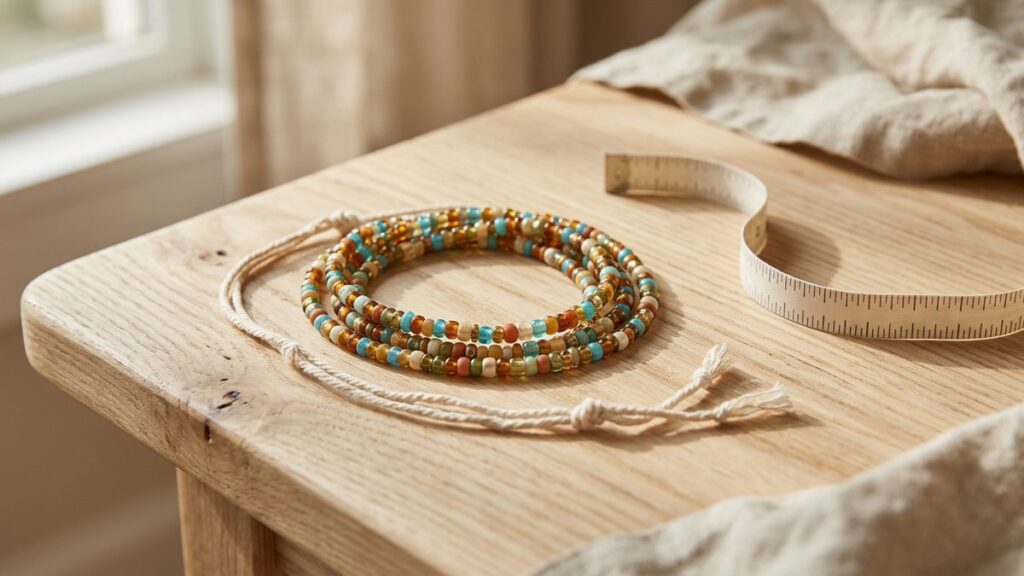
Waist beads are strands of small beads, usually glass, strung on string or wire and worn around the waist or hips. They have been important accessories for Ghanaian women for ages, the Ghana News Agency (GNA) reports.
Akan speakers call them “torma,” Ga speakers say “ashinor,” and in Ewe they are “ali dzonu.” They are also common among the Ada, the Dangme and many northern groups.
The tradition can start at birth: a newborn may wear a string or two of beads, whatever the baby’s gender. In most Ghanaian ethnic groups, it is a cultural norm for women to wear one or more strands.
Olivia Gerald, a beadmaker in Ashaiman, told GNA in a 2026 report that waist beads symbolize womanhood, fertility and strength and are often part of cultural identity. She also described a practical use: beads that fit tighter on a baby suggest healthy growth, and beads that loosen suggest weight loss.
Beads and rites of passage
Beads have been part of Ghana’s culture for centuries, from early stone, shell and bone beads to Krobo glass beads. They can symbolize status, wealth and spirituality, and they appear at marriages, naming ceremonies and the enstoolment of chiefs, the 2026 GNA report notes.
During the Krobo people’s annual Dipo ceremony, which initiates adolescent girls into adulthood, the young women are adorned with colorful waist beads and paraded through the streets, Good Morning America (GMA) reports.
Other meanings: sensuality, spirituality and protection
Caitlyn Kumi, founder of a company that employs women in Ghana to make waist beads, told GMA that people wear them to celebrate womanhood, sexuality, femininity, fertility, healing, spirituality, body shaping, protection and wealth. Her aunt, Ghanaian broadcaster Akushika Acquaye, added that grandmothers say beads give a woman a more beautiful figure that makes her more desirable to suitors.
Not everyone sees the beads positively. GNA’s 2022 report notes that some people link waist beads with spirituality, witchcraft and fetishism, and that women who wear them can be judged for it.
What do waist bead colors mean?
Gerald told GNA that bead colors can represent stages of life such as adulthood, grief and victory. That is one maker’s account, and GNA notes that colors differ by where the beads are made.
The detailed color charts you’ll find online mostly come from bead retailers. We found no authoritative source for a fixed color code, so ask the person who made your beads what their choices mean.
Waist bead history and traditions beyond Ghana
It’s hard to confirm when people began wearing waist beads, GMA notes, but several sources link them to ancient West African and Egyptian cultures, with dates reaching back to the 15th century.
In a 2024 peer-reviewed study from Nigeria, researchers interviewed 30 young women in Calabar, in the country’s southeast, who linked their beads to beauty, fertility, spirituality and femininity. The authors concluded that waist beads give these women a way to express themselves and shape their personal identity.
Most cultural detail in this article comes from Ghanaian reporting. Other traditions across West Africa have their own names and practices that we don’t cover here.
Who wears waist beads today
In Ghana, the norm is strongest in rural areas and small towns, GNA reports, but women in cities still wear beads for cultural and personal reasons. The women GNA interviewed named beauty, a curvier shape, attracting a partner, and heritage and pride.
Beads aren’t only for women. At ceremonies such as weddings and coronations, men and women alike wear beads, Acquaye told GMA. She added that waist beads are now worn by people from all walks of life.
Can people outside the culture wear waist beads?
Views differ, and no single authority decides. Kumi told GMA that the belief that only women of African origin can wear waist beads is a misconception. She also said that profiting from waist beads without giving their cultural context is appropriation, and urged buyers to choose businesses that ethically source beads from an African country or from people of African origin.
If you don’t come from a waist-bead tradition, that advice points to a respectful approach: buy from African beadmakers, learn what your beads mean, and don’t treat ceremonial styles as a costume.
How waist beads are worn
Waist beads are traditionally strung on thread or twine, then knotted or secured with a clasp. Jasai Madden, a waist bead designer, told GMA that traditionally made strands are non-elastic and permanent, meaning they are tied on to stay.
GNA notes that some women rarely take their beads off at all. Beads can also be worn on show: GMA reports that celebrities such as Beyoncé and Lupita Nyong’o have been spotted wearing a version wrapped around the midriff.
How people use waist beads for weight loss
The weight-tracking idea echoes the baby-growth use that beadmaker Olivia Gerald described: beads fit tighter as the body grows and looser as it shrinks. Because a strand tied at a fixed length can’t stretch, it reacts to changes around your middle.
Madden told GMA that a non-elastic strand signals you not to overeat and rises and falls like the numbers on a scale. That is a seller’s description, not a tested method: we found no studies of waist beads for weight loss.
In practice, the fit reads like this:
- Snugger: your waist may be growing, or you may simply be bloated after a big meal.
- Looser: your waist may be getting smaller.
How to set up beads as a waist cue
There is no official or tested method. If you want to try it, these steps keep the cue consistent:
- Choose a non-stretch cord. An elastic strand stretches and hides changes.
- Tie it snug but loose enough to slip a finger underneath, so it doesn’t dig in after meals. Madden told GMA that the higher you tie it, the sooner you get the signal.
- Leave the length alone. Re-tying it resets your starting point.
- Check the fit at the same time each week, such as in the morning before eating, so a big meal doesn’t skew it.
Confirm any change with a tape measure once a month, using the methods below.
What waist beads can’t tell you
Beads are a cue, not a measuring tool:
- No numbers. You can’t compare “a bit looser” with a health cutoff.
- Daily swings. A big meal, bloating or simply sitting down can change the fit within hours.
- No fixed spot. Beads can shift up or down, while health cutoffs depend on measuring at a set point, as the methods below show.
- No fat burning. Beads don’t shrink your waist. Eating and activity do the work.
A more reliable check: tape measure and waist-to-height ratio
Where you carry fat matters. The National Heart, Lung, and Blood Institute (NHLBI) says that if most of your fat sits around your waist rather than your hips, your risk of heart disease and type 2 diabetes is higher.
Measuring for the 35- and 40-inch cutoffs
The NHLBI’s method has two steps:
- Stand and place a tape measure around your middle, just above your hipbones.
- Read the tape just after you breathe out.
According to the NHLBI, a waist of more than 35 inches for women or more than 40 inches for men increases your risk.
Your waist-to-height ratio
For this ratio, England’s National Institute for Health and Care Excellence (NICE) uses a different spot. Find the bottom of your ribs and the top of your hips. Wrap the tape around your waist midway between those points, just above the belly button, and breathe out naturally before reading it.
The two spots can give slightly different numbers, so use the NICE spot for the ratio every time.
Next, divide your waist by your height, using the same units. NICE uses these bands for adults with a BMI under 35:
- 0.40 to 0.49: healthy, with no increased health risk
- 0.50 to 0.59: increased health risk
- 0.60 or more: further increased health risk
NICE says these bands apply to both sexes and all ethnicities, including adults with high muscle mass. The NHS puts it in one rule: try to keep your waist size to less than half your height.
| Your height | Keep your waist under |
|---|---|
| 5 ft 0 in (60 in) | 30 in |
| 5 ft 4 in (64 in) | 32 in |
| 5 ft 8 in (68 in) | 34 in |
| 6 ft 0 in (72 in) | 36 in |
| 6 ft 4 in (76 in) | 38 in |
For example, say you are 5 feet 6 inches tall (66 inches) and your waist, measured the NICE way, is 34 inches.
Your ratio is 34 divided by 66, or 0.52. That falls in the increased-risk band, even though 34 inches is under the 35-inch cutoff for women (and well under the 40-inch cutoff for men).
Where BMI fits
BMI still has a place, but the NHS notes that a BMI calculator can’t tell muscle from fat. NICE adds that people of Black African, African-Caribbean, South Asian, Chinese, other Asian or Middle Eastern background tend to carry fat around the middle and face heart and metabolic risk at a lower BMI. For them, NICE uses lower cutoffs: overweight from 23 and obesity from 27.5.
How to use waist beads alongside a real plan
Keep your beads as a reminder if you enjoy them, let the tape guide decisions, and focus on the habits that change your waist:
- Set a realistic calorie target. Our guide to how many calories you need to lose weight shows how to set one.
- Move every day. Our guide to walking and belly fat suggests how often and how hard to walk.
- Build meals around protein and fiber. Our roundup of foods that may help with belly fat covers picks such as oats, chickpeas and pumpkin.
- Track progress more than one way. Our tips for staying motivated suggest taking progress photos as well as weighing yourself.
Find more ideas in our weight loss tips section.
Safety: when to check with a doctor
- Beads loosening when you aren’t trying. MedlinePlus advises contacting your provider if you lose more than 10 pounds, or 5% of your normal body weight, over 6 to 12 months or less without knowing why.
- A high waist-to-height ratio. If your ratio is 0.5 or higher, NICE advises seeing a healthcare professional for further checks, such as a heart and metabolic risk assessment.
- Pregnancy. Your waist is supposed to grow, so loosen or remove beads and don’t use them to judge weight gain.
- Skin problems. Remove beads that leave deep marks, rub or cause a rash. GNA notes that beads worn constantly without washing can harbor bacteria from sweat, so clean them regularly.
- A history of eating disorders. If checking beads or a tape makes you anxious or leads to constant body checking, stop and talk with a doctor or therapist.
Frequently asked questions
What do waist beads mean?
It depends on the culture and the wearer. In Ghana, they can mark womanhood, fertility, strength and heritage, and they feature in rites of passage such as the Krobo Dipo ceremony. Many people also wear them for beauty, sensuality or as a waist-size cue.
What is the spiritual meaning of waist beads?
Waist bead company founder Caitlyn Kumi told GMA that people wear them for healing, spirituality and protection. Young women in the 2024 Calabar study in Nigeria also linked their beads to spirituality. Some people view that link with suspicion, and GNA reports that wearers can be judged for it.
Where did waist beads originate?
No one knows exactly. GMA reports that sources link the practice to ancient West African and Egyptian cultures, and beads have been part of Ghanaian culture for centuries.
What does it mean when waist beads break?
None of the cultural sources we reviewed gives a broken strand a fixed meaning. Usually the cord wore out, the strand was tied too tight, or your waist has grown. Restring the beads on a sturdy cord, and check any waist change with a tape measure.
Do waist beads help you lose weight?
Not directly, because beads don’t burn fat. A non-stretch strand can flag a changing waist, but only a tape measure gives you a number to compare with health cutoffs. Use beads as a reminder and let your eating and activity habits do the work.
Can anyone wear waist beads?
Views differ. Kumi, the waist bead company founder quoted by GMA, said they are meant for women of all shapes, sizes and races. Buying from African beadmakers and learning what the beads mean shows respect.
Sources
- Aim for a Healthy Weight, National Heart, Lung, and Blood Institute (NIH)
- Overweight and obesity management (NG246): Identifying and assessing overweight, obesity and central adiposity, National Institute for Health and Care Excellence
- Overweight and obesity in adults, NHS
- Weight loss – unintentional, MedlinePlus, U.S. National Library of Medicine
- Waist Beads: The much-loved traditional artifact, Ghana News Agency (2022)
- Ghanaian beadmakers keep tradition alive amid modernisation, Ghana News Agency (2026)
- Waist beads are the exquisite adornments tied to empowering women, celebrating rich culture, Good Morning America, ABC News (2021)
- They are Just for Making Nyángá: Ethnosemiotic Significance of Waist Beads Among Young Women in Nigeria, African Studies (2024), abstract via African Union Commission Library