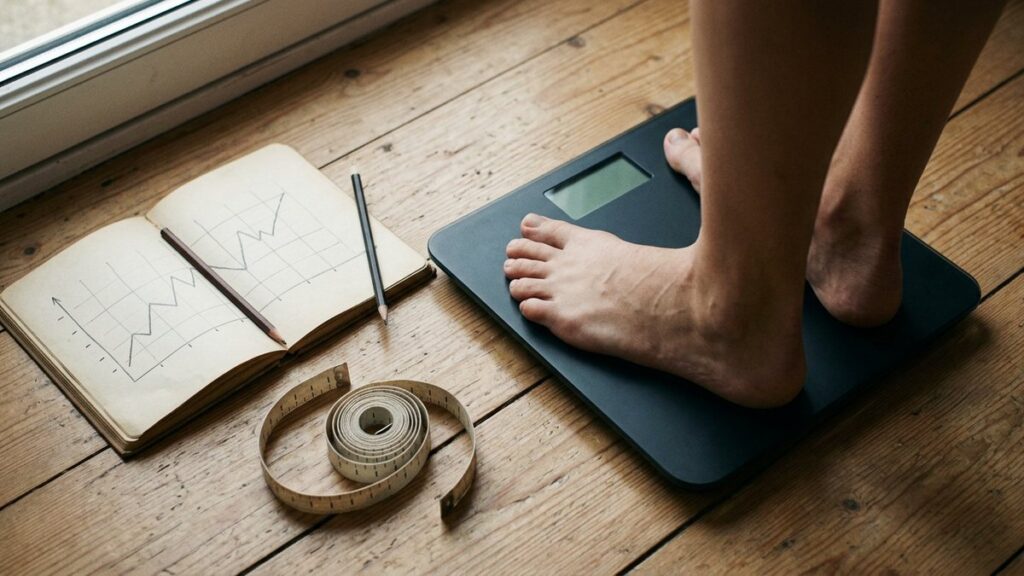
A weight loss plateau is a stretch of several weeks when your weight stops falling even though you are sticking to your plan. It usually arrives within the first year, mainly because your smaller body burns fewer calories while your appetite quietly rises until what you eat matches what you burn. To break it, confirm the stall is real, tighten your tracking, then adjust calories or activity, or decide you have reached a healthy maintenance weight.
Key takeaways
- Plateaus are expected. Modeling by an NIH scientist shows weight loss typically levels off within the first year of a diet, even when people keep trying.
- Appetite is the bigger force. For each kilogram (2.2 pounds) lost, appetite rises by about 100 calories a day, while calorie burn falls by only about 20 to 30.
- Metabolic adaptation is real, but in typical diets it is modest, and it shrinks once your weight stabilizes.
- Before you cut more food, check 3 to 4 weeks of weigh-ins and audit your tracking. Self-reported food intake usually falls well short of what people really eat.
- Sometimes a plateau is your body’s new maintenance weight, and holding it is a success.
What is a weight loss plateau?
A true weight loss plateau means your average weight has not dropped for several weeks while your eating and activity have stayed the same. Water shifts and tracking drift can also mimic a stall.
A short weight loss stall of a week or two is usually just normal scale noise. Body weight moves day to day with fluid, salt, how much food is in your gut and, for many women, the menstrual cycle.
Early weight loss also looks faster than it really is. When you cut calories, your body uses up glycogen, its stored carbohydrate, and the water bound to it. Glycogen stores average about 400 to 500 grams, with 3 to 4 grams of water bound to each gram, so part of the first drop is water, not fat, and that part ends once stores run low (Martins et al., American Journal of Clinical Nutrition).
A practical rule of thumb: weigh yourself under the same conditions most mornings and compare weekly averages. If the average has not moved for 3 to 4 weeks, treat it as a plateau. Anything shorter is probably water.
Why a weight loss plateau happens
A smaller body burns fewer calories
The old rule that every 3,500-calorie deficit equals one pound lost ignores how the body adapts. A review of weight maintenance by NIH researcher Kevin Hall and obesity physician Scott Kahan estimates that for every kilogram you lose, you burn about 20 to 30 fewer calories a day. You are moving a lighter body, and you have less tissue to maintain.
That means a fixed diet will always level off. In a Lancet modeling study led by NIH researchers, a 220-pound sedentary man who permanently cut 480 calories a day was predicted to level off near 165 pounds. It took about a year to reach half of that loss and about three years to reach 95% of it, even with perfect adherence.
The same model gives a handy rule of thumb: each lasting change of 10 calories a day eventually shifts weight by about 1 pound.
Appetite rises below your awareness
In a study that measured how appetite fights weight loss, adults with type 2 diabetes took a drug that makes the body lose sugar in urine. They lost weight without noticing a calorie deficit.
Even so, their appetite rose by about 100 calories a day for every kilogram lost. That pull was more than three times larger than the drop in calorie burn.
Hall and Kahan modeled what this looks like at a typical plateau. Calorie burn had fallen by less than 200 calories a day. Appetite, though, had risen by 400 to 600 calories a day, and actual intake had crept up by 600 to 700 calories a day since the diet began.
People often feel they are eating the same as before. Portions can grow slowly, and normal day-to-day swings of 20% to 30% in how much we eat hide the drift.
Metabolic adaptation: real, but usually smaller than you think
Metabolic adaptation, also called adaptive thermogenesis, means your resting metabolism drops more than your new size alone would predict. In one study of 71 adults with obesity on a 1,000-calorie diet, people lost an average of 14 kg in 8 weeks.
Their resting metabolism was about 92 calories a day lower than predicted at the end of the diet. After 4 weeks of stable weight, the gap had shrunk to about 38 calories. In those with data at one year, it was no longer significant.
Extreme weight loss is different. Contestants on “The Biggest Loser” lost an average of 58 kg in 30 weeks. A six-year follow-up of these contestants found their resting metabolism was still about 500 calories a day below predicted.
For a typical diet, though, so-called starvation mode does not stop weight loss on its own. It trims your calorie deficit a little, and rising appetite does most of the work.
Tracking drift
Even careful people misjudge intake. A review of energy balance measurement found that self-reported intake runs hundreds of calories a day below true intake, and that exercise is often overreported. Watch for the usual gaps: cooking oil, sauces, drinks, bites while cooking and weekends.
Short sleep
In a small randomized crossover study, 10 adults followed the same calorie-reduced diet for 14 days, once with 8.5 hours in bed and once with 5.5 hours. With short sleep, fat loss fell from 1.4 kg to 0.6 kg, loss of lean mass rose from 1.5 kg to 2.4 kg and hunger increased. Read more in our guide to how sleep affects weight loss.
Weight loss plateau causes and fixes at a glance
| Cause | Clues | What to do |
|---|---|---|
| Lower calorie needs | Loss slowed gradually over months on the same plan | Recalculate calories at your current weight, then make one small change |
| Rising appetite and portion creep | You feel hungrier, portions look bigger, snacks crept back | Pre-portion meals, build them around protein and vegetables, and plan snacks |
| Tracking drift | You log less often, guess portions or skip weekends | Log everything with a food scale for 1 to 2 weeks |
| Water retention | A sudden jump after a salty meal, a hard new workout or before a period | Wait, and judge the 3- to 4-week trend |
| Less daily movement | Fewer steps or more sitting than when you started | Restore your step count and add strength training |
| Short sleep | Less sleep and more cravings | Set a regular bedtime and protect your sleep window |
| Medication or health issue | A new medicine, or symptoms such as unusual tiredness | Ask your clinician to review your medicines and health |
| You have reached maintenance | You eat a reasonable amount, health markers have improved and cutting more feels unsustainable | Switch to a maintenance plan |
How to break a weight loss plateau: 7 steps in order
- Confirm the plateau. Use 3 to 4 weeks of weekly averages, not one bad weigh-in. Also check your waist measurement and how your clothes fit.
- Audit your intake for 1 to 2 weeks. Weigh and log everything, including cooking oil, drinks, condiments, tastes and weekends. This step often shows that the deficit has quietly closed.
- Recalculate your calorie needs. Your target from 20 pounds ago no longer fits. Use our guide to how many calories you need to lose weight to recalculate your target at your current weight.
- Make one change at a time. Trim a modest amount of food, such as one snack or one sugary drink, or add activity. Give it 3 to 4 weeks. Guidelines usually set weight-loss diets at 1,200 to 1,500 calories a day for women and 1,500 to 1,800 for men, and reserve diets under 800 calories for medical settings, so don’t go below that range without a clinician. Because each 10 calories a day equals roughly 1 pound over time, small changes work slowly but they add up.
- Make the smaller intake easier to live with. Eat regular meals built around lean protein, vegetables, beans and whole grains. Keep high-calorie snacks out of easy reach and favor foods you eat, not drink.
- Move more, and lift. Add daily steps and regular strength training. Our guide to how to increase metabolism covers what helps and what is hype.
- Protect your sleep and review your medicines. Aim for a steady sleep schedule. If nothing moves after these steps, ask your clinician whether a medication or condition could be playing a role, and whether medical treatment for obesity makes sense for you.
On a low-carb or keto plan? See our guide to breaking a low-carb weight loss stall for diet-specific fixes.
How long does a weight loss plateau last?
It depends on the cause. A water-driven stall usually clears on its own once the cause passes, such as after your period or after a run of salty meals ends.
A true energy-balance plateau has no built-in end date. It lasts until something changes, because your intake and your burn now match.
Hall and Kahan describe a common pattern: fast early weight loss, a plateau within the first year and then slow regain as effort fades. If you keep eating and moving the same way, the plateau is likely your new balance point, not a pause.
That is not failure. It means it is time to decide on your next step.
When a plateau means you’ve reached your maintenance weight
Not every plateau needs breaking. Modest losses bring large health gains. According to the Hall and Kahan review, a 7% weight loss in the Diabetes Prevention Program cut new cases of type 2 diabetes by 58%, and a 6% loss over eight years in the Look AHEAD trial improved several heart risk factors.
Your plateau may be a good place to stay if:
- You eat enough to feel well, and cutting further would mean constant hunger or skipping social meals
- Your blood pressure, blood sugar, cholesterol, mobility or sleep have improved
- You can keep up your current eating and activity habits for years, not weeks
- Your clinician agrees your current weight is a healthy target for you
If that sounds like you, shift to maintenance. Keep weighing regularly, keep your activity and use your current calorie intake as your baseline.
You can always plan another weight loss phase later. Browse more practical guides in our weight loss section.
When to talk to a doctor
- You take diabetes medicine, especially insulin or a sulfonylurea. Eating less can raise the risk of low blood sugar, so ask before you cut further.
- You have a history of an eating disorder, or you notice obsessive tracking, bingeing or fear of eating. Get support before you change your plan.
- You are pregnant or breastfeeding. Weight loss goals need medical guidance during this time.
- You gain weight without a clear reason, or have swelling, unusual fatigue or other new symptoms. These need a medical check.
- You use a GLP-1 medicine such as Wegovy or Zepbound. Weight also levels off on these drugs. Do not change your dose without your prescriber.
Frequently asked questions
How long does a weight loss plateau last?
Water-related stalls usually pass on their own once the cause settles. A true plateau lasts until you change your intake or activity, because your calories in and out now match. If 3 to 4 weeks pass with no change in your weekly average, it is time to audit and adjust.
Is starvation mode real?
Partly. Resting metabolism can drop a little more than expected during dieting, but in typical diets the gap is small. In one well-controlled study it was under 100 calories a day, and it shrank once weight stabilized. Rising appetite is a bigger reason weight loss stalls.
Should I eat more to break a weight loss plateau?
Eating more will not, by itself, restart fat loss. Some people take a planned break at maintenance calories to rest from dieting, which is fine if you track it. If you are eating very little and feel unwell, talk to a clinician or dietitian about a safer target.
Can exercise break a weight loss plateau?
It can help, especially if your daily movement dropped as you lost weight. Strength training also helps protect muscle. Exercise works best alongside an honest check of how much you eat, because people often overestimate the calories they burn.
How do I know if it’s a plateau or water weight?
Look at the trend. Water weight shows up as sudden jumps that soon fade, often after salty meals, hard workouts or around a period. A plateau is a flat weekly average for 3 to 4 weeks. Waist measurements that keep shrinking suggest you are still losing fat.
Is it normal to hit a plateau on Wegovy or Zepbound?
Yes. The Hall and Kahan review notes that different treatments produce different amounts of weight loss, but the overall pattern of fast loss followed by a stall is similar. A stall on these medicines is not a reason to change your dose on your own. Ask your prescriber whether your dose, eating or activity needs adjusting.
Sources
- Hall KD, Kahan S. Maintenance of lost weight and long-term management of obesity. Medical Clinics of North America, 2018.
- Hall KD, et al. Quantification of the effect of energy imbalance on bodyweight. The Lancet, 2011.
- Polidori D, et al. How strongly does appetite counter weight loss? Quantification of the feedback control of human energy intake. Obesity, 2016.
- Martins C, et al. Metabolic adaptation is an illusion, only present when participants are in negative energy balance. American Journal of Clinical Nutrition, 2020.
- Fothergill E, et al. Persistent metabolic adaptation 6 years after “The Biggest Loser” competition. Obesity, 2016.
- Dhurandhar NV, et al. Energy balance measurement: when something is not better than nothing. International Journal of Obesity, 2015.
- Nedeltcheva AV, et al. Insufficient sleep undermines dietary efforts to reduce adiposity. Annals of Internal Medicine, 2010.
- Jensen MD, et al. 2013 AHA/ACC/TOS Guideline for the Management of Overweight and Obesity in Adults. Circulation, 2014.