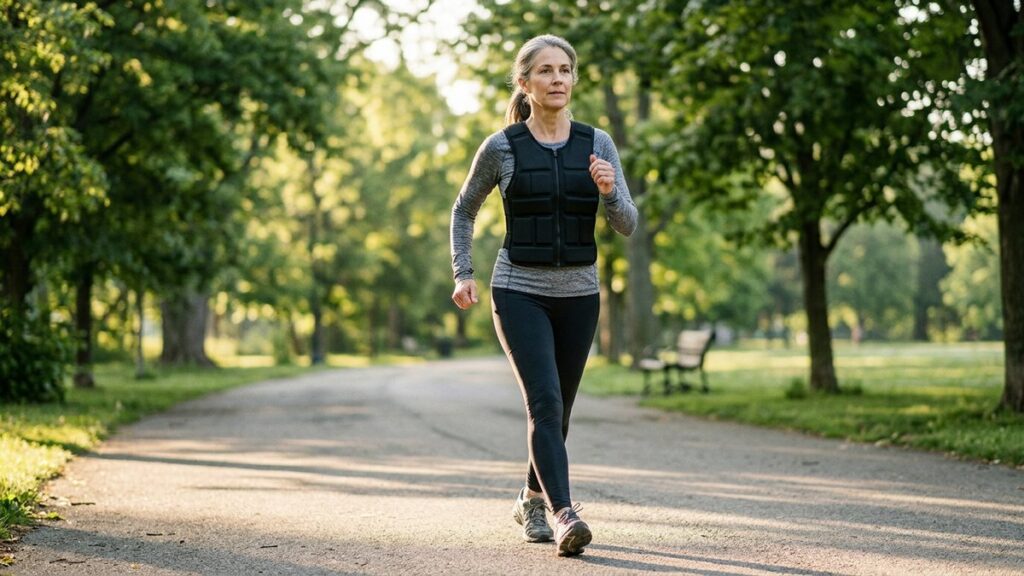
Weighted vest walking means walking while wearing a snug vest that holds extra weight. It makes each walk a little harder: a vest at 10% of body weight raised energy use by about 7% in a lab study (Dossou et al., European Journal of Applied Physiology, 2026). But in the largest trial so far, wearing a vest during weight loss did not protect older adults’ hip bones (Beavers et al., JAMA Network Open, 2025).
Key takeaways
- The extra calorie burn is small. For a 185-pound person, a vest adds roughly 10 to 15 calories to a 30-minute walk. Walking 10 minutes longer adds more.
- In a 12-month trial of 150 older adults losing weight, wearing a vest about 7 hours a day did not reduce hip bone loss compared with dieting alone.
- In the same trial, supervised strength training did more for thigh muscle than the vest.
- Start light, around 5% of your body weight, and stay at or below 10%.
- Skip the vest, or get medical clearance first, if you have osteoporosis with a past fracture, are pregnant or have back problems.
What weighted vest walking actually does
Carrying more weight makes your legs, heart and lungs work harder at the same pace. In a 2026 study, 13 sedentary adults with overweight or mild obesity walked on a treadmill at 2.5 to 3.4 mph with and without a vest weighing 10% of their body weight (Dossou et al., 2026). With the vest:
- Energy use rose 7.1% on average, from 6.1% more at the slowest speed to 9.7% more at the fastest.
- Heart rate rose 4.4%.
- Walks felt harder at every speed.
Most participants were young men (11 of 13), so the numbers may differ for older women. The pattern makes sense, though: the vest raises intensity without making you walk faster, which helps if speed is limited by joints or fitness.
How many extra calories is that?
Harvard Health estimates that 30 minutes of walking at 3.5 mph burns about 107 calories for a 125-pound person, 133 for a 155-pound person and 159 for a 185-pound person (Harvard Health Publishing). Adding 6% to 10% to those figures gives:
| Body weight | 30-minute walk, no vest | Extra with a 10% vest | Extra from walking 10 more minutes, no vest |
|---|---|---|---|
| 125 lb | About 107 calories | About 7 to 10 | About 36 |
| 155 lb | About 133 calories | About 8 to 13 | About 44 |
| 185 lb | About 159 calories | About 10 to 15 | About 53 |
The takeaway: a vest is a way to make walking harder, not a fat-loss shortcut. If calories are your goal, extra minutes, hills or intervals do more. Our guide to cardio exercises for weight loss has other options.
Weighted vest benefits: what the research shows
Bone density during weight loss
In older adults, weight loss is linked with bone loss, which raises the risk of fractures. The idea behind the vest is simple: replace the lost pounds with external weight so bones keep feeling the load.
The INVEST in Bone Health trial tested this in 150 older adults, most living with obesity, average age 66, 75% of them women. All three groups cut calories and lost 9% to 11% of their body weight over 12 months (Beavers et al., 2025):
- Diet only.
- Diet plus vest: participants wore the vest about 7.1 hours a day, and it replaced 78% of the weight they lost on average.
- Diet plus strength training: supervised sessions 3 times a week.
Every group lost 1.2% to 1.9% of bone density at the hip. The vest group did no better than diet alone, and strength training did no better either. The authors concluded that exercise may not be enough on its own to stop bone loss during weight loss.
A follow-up analysis found that, within the vest group, people who spent more time standing and moving had better hip bone results on one type of scan. The authors say this finding needs testing in new trials (Fanning et al., Frontiers in Aging, 2026).
Earlier, smaller studies were more encouraging. As the INVEST authors summarize, older women who wore vests while exercising 30 to 60 minutes a day, 3 days a week, saw benefits for bone turnover and hip bone density, and one 5-year program of vest exercise classes prevented the 3% to 4% decline in hip bone density seen with aging. Those were structured exercise classes, not ordinary walks (Beavers et al., 2025).
Muscle and strength
In a muscle analysis of INVEST, strength training increased thigh muscle size and improved muscle quality. The vest group showed only a trend toward better trunk muscle quality (4.2%, not statistically significant) and no clear differences from diet alone (Lynch et al., Journals of Gerontology, 2026).
An earlier 22-week pilot trial put 37 adults aged 65 to 79 on a 1,100 to 1,300 calorie diet, with or without a vest. Both groups lost about 11 kg. The diet-only group lost more leg power than the vest group, while other strength and function results did not differ (Normandin et al., Journal of Frailty and Aging, 2018).
So if keeping muscle is your main goal, strength training is the stronger tool. Start with our list of the best strength training exercises for weight loss.
Weight loss itself
The vest did not change how much weight people lost. In the pilot trial, the diet group lost 11.2 kg and the diet-plus-vest group lost 11.0 kg (Normandin et al., 2018). In INVEST, weight loss was similar across all three groups. The calorie deficit did the work.
Weighted vest for women
Women made up 112 of the 150 INVEST participants, so the main trial results apply directly to older women. Osteoporosis is the major cause of fractures in postmenopausal women, and the NIH recommends weight-bearing exercise such as walking to help prevent it (NIAMS). Plain walking already counts. A vest adds load, but it has not been shown to stop bone loss during weight loss.
Fit matters more than brand. Look for a vest that adjusts at the sides, sits high and snug on the chest and back, and does not bounce or press uncomfortably. For stories from people who lost weight later in life, see our weight loss success stories over 50.
What weight vest should I start with?
Start around 5% of your body weight and build toward no more than 10%. There is no official guideline, so this is our conservative range. Here is the reasoning:
- INVEST began with an empty 1-pound vest and added weight weekly in ⅛-pound blocks, never above 10% of a participant’s starting weight (Beavers et al., 2025).
- The 2026 metabolic study chose 10% of body weight for comfort and still measured clear increases in effort (Dossou et al., 2026).
- The INVEST authors note that walking with a vest of just 5% of body weight already increased the load on the skeleton.
| Your weight | Starting load (about 5%) | Upper limit (10%) |
|---|---|---|
| 140 lb | 7 lb | 14 lb |
| 160 lb | 8 lb | 16 lb |
| 180 lb | 9 lb | 18 lb |
| 200 lb | 10 lb | 20 lb |
| 240 lb | 12 lb | 24 lb |
If your vest only comes in fixed sizes, round down. If you are actively losing weight, one research-based approach is to load the vest with about the weight you have lost so far, up to the 10% limit.
How to start weighted vest walking: a 6-week plan
This is our conservative progression. Change only one thing at a time, either the load or the minutes, and keep the rest of each walk vest-free until you reach the full time.
| Week | Vest load | Minutes with the vest | Vest walks per week | Notes |
|---|---|---|---|---|
| 1 | Empty vest or up to 5% | 10–15 | 2–3 | Flat routes only; check how your back and feet feel the next day |
| 2 | 5% | 15–20 | 3 | Same easy pace as your normal walks |
| 3 | 5% | 20–30 | 3 | Add gentle slopes only if you have no pain |
| 4 | 7–8% | 20 | 3 | Drop the minutes back when the load goes up |
| 5 | 7–8% | 30 | 3–4 | Keep at least one rest day between vest walks |
| 6 | Up to 10% | 20–30 | 3–4 | Stay here; more weight is not needed |
Hold a stage for an extra week if anything aches. Go back a stage if pain lasts into the next day.
Posture, back and joint risks
Extra weight means extra stress on the back, hips, knees and feet. In INVEST, the vest group reported 17 musculoskeletal adverse events, similar to the strength-training group (19) and nearly three times the diet-only group (6). None of the serious adverse events were linked to the interventions (Beavers et al., 2025). In the pilot trial, 5 of 20 vest wearers reported back pain or soreness (Normandin et al., 2018).
To lower the risk:
- Wear the vest snug and high, with the weight split evenly front and back.
- Stand tall. Do not lean forward or let your shoulders round.
- Keep a normal stride and arm swing. Do not add ankle or wrist weights.
- Wear supportive walking shoes and choose even ground at first.
- Do not run or jump in the vest until you are comfortable walking in it.
- Vests trap heat. Walk in cooler hours, drink water and take the vest off if you feel dizzy or overheated.
Who should avoid a weighted vest
- Osteoporosis, especially with a past fracture: INVEST excluded people with osteoporosis, severe arthritis or back pain, so we have no trial safety data for them (Beavers et al., 2025). Fragile bones can break from minor falls, and spine fractures can cause severe back pain and a stooped posture (NIAMS). Ask your doctor or a physical therapist before adding load. Plain walking is still encouraged.
- Pregnancy: ACOG notes that pregnancy shifts your center of gravity, stresses the pelvis and lower back and raises the risk of falling. It also advises avoiding overheating (ACOG). A vest adds to all three, so skip it.
- Back problems: back pain was the main complaint in the pilot trial. If you have a disc problem, spinal stenosis or ongoing back pain, get clearance first.
- Heart conditions or uncontrolled blood pressure: INVEST excluded people with a recent heart attack, unstable angina or uncontrolled high blood pressure. The vest raises heart rate, so talk to your doctor first.
- Balance problems or recent falls: extra weight can make a stumble harder to recover from.
Frequently asked questions
Does walking with a weighted vest burn belly fat?
Not in any special way. A vest at 10% of body weight adds only about 6% to 10% to the energy cost of a walk. Fat loss, including from the belly, comes from your overall calorie deficit. Read more in our article on whether walking burns belly fat.
Is a weighted vest good for bone density?
The best evidence says not during weight loss. In the 12-month INVEST trial, wearing a vest about 7 hours a day did not reduce hip bone loss. Older, smaller studies found benefits when older women wore vests during structured exercise classes.
How long should I wear a weighted vest when walking?
Start with 10 to 15 minutes of a walk you already do comfortably, then build up over several weeks. INVEST participants wore vests for hours a day, but they began with an empty vest and added weight in small weekly steps as part of a monitored study.
What weight vest should a woman start with?
Use the same rule as anyone else: about 5% of your body weight, up to a maximum of 10%. For a 150-pound woman, that means starting around 7 to 8 pounds and stopping at 15.
Will a weighted vest help me lose more weight?
Probably not by much. In two trials, people who wore vests lost the same amount of weight as those who only dieted. Use the vest to add challenge to walks, and rely on your eating plan for weight loss.
Explore more workouts in our Exercise & Fitness section.
Sources
- Beavers KM et al. Weighted vest use or resistance exercise to offset weight loss-associated bone loss in older adults: a randomized clinical trial, JAMA Network Open, 2025
- Lynch SD et al. Weighted vest use or resistance exercise to offset muscle loss in older adults: secondary findings from the INVEST in Bone Health RCT, Journals of Gerontology, Series A, 2026
- Fanning J et al. Does time spent upright moderate the influence of a weighted vest on change in bone mineral density during weight loss among older adults?, Frontiers in Aging, 2026
- Normandin E et al. Feasibility of weighted vest use during a dietary weight loss intervention and effects on body composition and physical function in older adults, Journal of Frailty and Aging, 2018
- Dossou J et al. Validity of energy expenditure from combined accelerometry and heart rate during load carriage in adults with overweight to mild obesity, European Journal of Applied Physiology, 2026
- Calories burned in 30 minutes for people of three different weights, Harvard Health Publishing
- Osteoporosis, National Institute of Arthritis and Musculoskeletal and Skin Diseases (NIAMS)
- Exercise During Pregnancy, American College of Obstetricians and Gynecologists (ACOG)