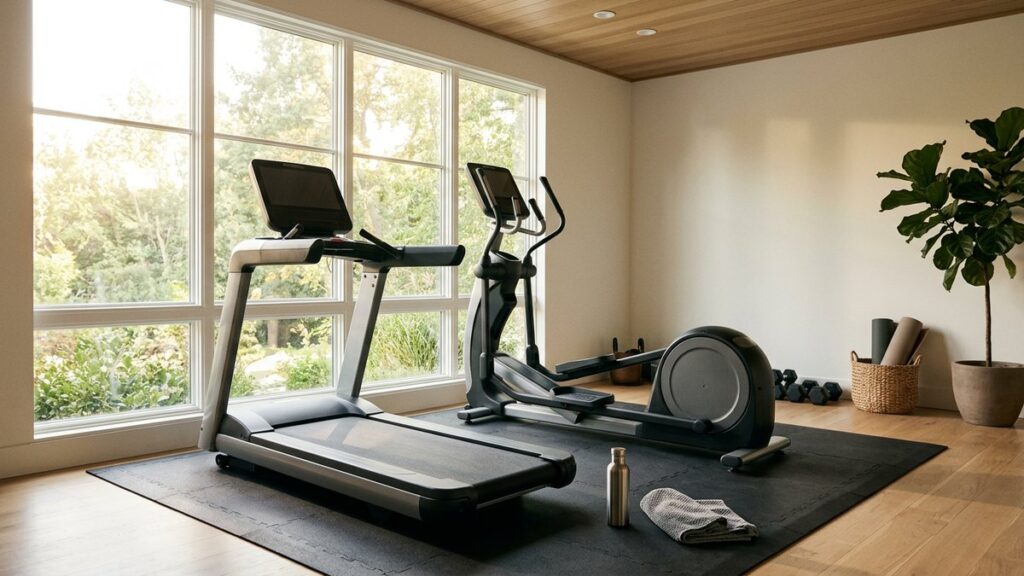
When you compare the elliptical vs treadmill for weight loss, neither machine wins outright. The treadmill can burn more calories when you push hard, while the elliptical puts less force on the knees than running. The bigger factor is how hard and how often you train, so pick the machine you will use at a challenging pace week after week.
Key takeaways
- How hard you work matters more than which machine you choose.
- In a lab study, fit men working at the same “very hard” effort burned about 15.2 calories a minute on a treadmill and 12.8 on an elliptical.
- Harvard Health estimates 30 minutes on an elliptical burns 270 to 378 calories for people weighing 125 to 185 pounds.
- The elliptical puts less force on the knee than jogging, but in one small study it did not load the knee less than treadmill walking.
- Brisk treadmill walking and jogging match the weight-bearing exercises NIH lists for bone health. The elliptical is weight-bearing too, but lower impact, so it loads bones less.
Elliptical vs treadmill for weight loss at a glance
| Factor | Treadmill | Elliptical |
|---|---|---|
| Calories at the same hard effort | Higher in a lab study of fit men | About 16% lower than the treadmill in that study |
| Impact | Low when walking, high when running | Low; your feet never leave the pedals |
| Knee load | Walking: no higher than the elliptical in a small study. Jogging: higher | Lower than jogging |
| Muscles | Legs and hips, in a natural walking or running pattern | Legs and hips; arms too if you push and pull the handles |
| Bone loading | Brisk walking and jogging are listed weight-bearing exercises | Low-impact weight bearing; each foot averaged 70% to 81% of body weight in one study |
| Best for | Walkers, runners and anyone who wants bone-loading cardio | People who cannot run comfortably or want low-impact intervals |
Elliptical vs treadmill calories per 30 minutes
Harvard Health publishes estimates of calories burned in 30 minutes for people who weigh 125, 155 and 185 pounds. It lists treadmill-style workouts by speed rather than by machine, so use the walking or running row that matches your treadmill speed.
| Activity (30 minutes) | 125 lb | 155 lb | 185 lb |
|---|---|---|---|
| Walking, 3.5 mph (17-minute mile) | 107 | 133 | 159 |
| Stair step machine, general | 180 | 216 | 252 |
| Running, 5 mph (12-minute mile) | 240 | 288 | 336 |
| Elliptical trainer, general | 270 | 324 | 378 |
| Running, 7.5 mph (8-minute mile) | 375 | 450 | 525 |
Source: Harvard Health Publishing. Treat these as rough estimates.
Two patterns stand out. Heavier people burn more on any machine. And a steady elliptical session burns far more than walking at 3.5 mph, while running at 7.5 mph burns more than either.
Harvard does not define the effort behind “general” elliptical use, which is one reason the next study matters.
Which burns more at the same effort?
A 2024 study compared seven indoor cardio machines in 30 recreationally active men aged 35 to 49 who were used to all of them. Each man did 12-minute bouts at a “very hard” effort and at maximum effort. The treadmill produced the highest calorie burn, heart rate and oxygen use, followed by the stair climber and then the elliptical, per the study in Frontiers in Sports and Active Living.
At the “very hard” effort, the men burned about 15.2 calories a minute on the treadmill, 13.4 on the stair climber and 12.8 on the elliptical. Over 30 minutes, that works out to roughly 455, 400 and 385 calories (our calculation). One reason the authors offer: a treadmill lets you change your stride freely, while an elliptical locks your feet into a set path.
Keep the limits in mind. These were fit, experienced men in short bouts, so your numbers will differ. The authors also note that at least one earlier study, in untrained college students, found no significant calorie difference between the treadmill and the elliptical.
Should you trust the calorie number on the screen?
Use it as a rough guide. The console estimates calories from a formula; it does not measure the oxygen you use. Enter your weight if the machine asks for it, and use the number to compare your own workouts over time rather than as an exact count.
Which burns more fat, elliptical or treadmill?
The treadmill came out ahead in one lab test. In nine healthy men, peak fat burning during exercise was about 0.61 grams a minute on the treadmill and 0.41 grams a minute on the elliptical. Fat burning also peaked at a harder effort on the treadmill, at 56% vs. 37% of peak oxygen uptake, reports the study in the Journal of Sports Science and Medicine.
That is fat used as fuel during a workout, not body fat lost over months. Over weeks, the total calories you burn and the food you eat matter far more than the fuel mix in one session. For more on fat loss from cardio, see our guide to cardio exercises for weight loss.
Elliptical vs treadmill for knees and joints
The elliptical is low impact because your feet stay on the pedals. In 30 healthy adults, each foot carried an average of 70% to 81% of body weight during elliptical exercise. The authors concluded that elliptical training reduces weight bearing even at higher resistance and incline, according to a study in the Orthopaedic Journal of Sports Medicine.
But low impact does not always mean less knee stress than walking. Researchers fitted three people with knee replacements that could measure force inside the joint. Elliptical exercise produced lower knee forces than jogging, but not lower than treadmill walking, according to the study in Clinical Orthopaedics and Related Research.
Long-term data lean toward the elliptical. A study followed 415 adults with overweight or obesity for four years using knee MRI scans. People who used an elliptical trainer showed the smallest increase in structural knee damage, and those in high-impact and racquet sports showed the largest, reports the study in Skeletal Radiology.
This was an observational study, so it cannot prove the elliptical protected anyone’s knees.
How to choose if you have knee pain
- If running hurts, switch to the elliptical or to treadmill walking. Both put less force on the knee than jogging.
- If walking feels fine, the treadmill is a reasonable choice. In the implant study, treadmill walking was no harder on the knee than the elliptical.
- Start easy. Begin with 10 to 15 minutes at low resistance or a flat treadmill, then add time before you add intensity.
- Watch the next day. If your knee is more painful or swollen the morning after, cut back the time or resistance.
- Get checked if exercise causes sharp pain, swelling, locking or a feeling that the knee gives way. A physical therapist can tailor a plan.
Muscles used on each machine
Both machines mainly work the legs and hips. Ellipticals with moving handles also let you use your arms and legs together, which the authors of the seven-machine study suggest is one reason it burned more than the bikes and rower. On a treadmill, you can raise the incline to make walking harder without running.
Neither machine replaces strength training. Cardio burns calories, but lifting or body-weight exercises build and keep muscle. Our list of the best exercises for weight loss at home includes moves you can add on non-cardio days.
Bone loading: an edge for the treadmill
Weight-bearing exercise puts force on your bones, which makes them work harder. The National Institute of Arthritis and Musculoskeletal and Skin Diseases lists brisk walking at 3 to 4 mph, jogging or running, and climbing stairs as examples, along with resistance training.
The elliptical is not on that list. You stand on it, so it still counts as weight-bearing, but it is low impact and reduces the load on your feet.
Brisk treadmill walking or jogging, plus strength training, is the more direct choice if bone health is a goal. If you have osteoporosis or a past fracture, ask your health care provider which activities are safe for you.
Sample workouts for each machine
Use a 0 to 10 effort scale:
- 3: easy
- 5 to 6: you can talk but not sing
- 8: you can say only a few words
Warm up and cool down for 5 minutes at an easy pace in every workout.
Treadmill workouts
- Beginner incline walk (30 minutes): walk at effort 5 to 6 for 20 minutes. Every 5 minutes, raise the incline by 1% if it feels manageable.
- Walk-jog intervals (about 30 minutes): 6 rounds of 1 minute jogging at effort 7 and 2 minutes brisk walking at effort 4 to 5.
- Hill repeats (about 35 minutes): 8 rounds of 1 minute walking at a steep incline at effort 8, then 2 minutes flat and easy.
Elliptical workouts
- Steady session (30 minutes): 20 minutes at effort 6, using the handles.
- Resistance ladder (30 minutes): raise the resistance one level every 2 minutes for 10 minutes, then lower it one level every 2 minutes for 10 minutes. Keep your pace steady.
- Intervals (about 25 minutes): 8 rounds of 30 seconds hard at effort 8 and 90 seconds easy at effort 3 to 4.
Short on time? Interval sessions pack more work into fewer minutes. Our guide to HIIT workouts for weight loss explains how to build up to them safely.
Stairmaster vs elliptical
The two are close. Harvard’s table puts a “general” elliptical session above a “general” stair step session, at 324 vs. 216 calories in 30 minutes for a 155-pound person.
In the seven-machine lab study, where both were done at the same hard effort, the stair climber burned slightly more, at about 13.4 vs. 12.8 calories a minute. The takeaway is the same as with the treadmill: effort drives the burn.
So which should you choose?
Choose the treadmill if you like walking or running, want the highest calorie burn when you push hard, or want cardio that loads your bones. Walking is also free outside, as our article on whether walking burns belly fat explains.
Choose the elliptical if running bothers your joints, you want low-impact intervals, or you simply enjoy it more. A machine you enjoy is a machine you will keep using.
Buying for home? Try both for at least 10 minutes first. Fit and comfort tell you more than a spec sheet.
Check floor space and ceiling height before you buy, since you stand higher on an elliptical’s pedals, and a running treadmill needs a longer deck. Many people get the best of both by alternating machines through the week.
How much cardio do you need to lose weight?
The Physical Activity Guidelines for Americans call for 150 to 300 minutes of moderate-intensity aerobic activity a week, or 75 to 150 minutes of vigorous activity, plus muscle-strengthening work on 2 or more days. People who want to lose more than 5% of their body weight, or keep a large loss off, may need more than 300 minutes a week of moderate activity.
On the effort scale above, a 5 or 6 counts as moderate and a 7 or 8 as vigorous. The guidelines add that cutting calories and exercising together works better for weight loss than either one alone.
Who should check with a doctor first
Talk with your health care provider before starting a new cardio routine if you have heart disease, chest pain or dizziness with exertion, uncontrolled high blood pressure, diabetes, a joint replacement, osteoporosis or a recent injury, or if you are pregnant. Stop and seek care if you feel chest pain, severe shortness of breath or faintness while exercising.
Find more workout guides in our exercise and fitness section.
Frequently asked questions
Which burns more calories, the elliptical or the treadmill?
At the same hard effort, the treadmill burned more in a 2024 lab study, about 15.2 vs. 12.8 calories a minute. At everyday effort, it depends on your speed and resistance: in Harvard’s estimates, a steady elliptical session beats walking at 3.5 mph, but running at 7.5 mph beats both.
Is the elliptical better for bad knees?
It is easier on the knees than jogging. In a small study using implants that measured knee force, though, the elliptical was not gentler than treadmill walking. If walking is comfortable, either machine can work. If running hurts, the elliptical is the better cardio choice.
Does the elliptical work your arms?
Yes, if it has moving handles and you actively push and pull them. The legs still do most of the work. For real upper-body strength, add resistance exercises such as push-ups or rows.
Can you lose weight using only the elliptical?
Yes. Any cardio machine can support weight loss if you use it regularly at a challenging effort. Pair it with changes to what you eat, because the calories you take in matter as much as the calories you burn.
Is the elliptical or treadmill better for belly fat?
Neither machine targets belly fat. Both help by raising the calories you burn. Combined with eating changes, that lowers total body fat, including around your waist.
Sources
- Calories burned in 30 minutes of leisure and routine activities, Harvard Health Publishing
- Energy expenditure, oxygen consumption, and heart rate while exercising on seven different indoor cardio machines at maximum and self-selected submaximal intensity (Prieto-González and Yagin, 2024), Frontiers in Sports and Active Living
- Maximal Fat Oxidation: Comparison between Treadmill, Elliptical and Rowing Exercises (Filipovic et al., 2021), Journal of Sports Science and Medicine
- Clinical Implications of Changing Parameters on an Elliptical Trainer (Kaplan et al., 2014), Orthopaedic Journal of Sports Medicine
- In vivo knee forces during recreation and exercise after knee arthroplasty (D’Lima et al., 2008), Clinical Orthopaedics and Related Research
- Impact of different physical activity types on knee joint structural degeneration assessed with 3-T MRI in overweight and obese subjects (Schirò et al., 2021), Skeletal Radiology
- Physical Activity Guidelines for Americans, 2nd edition, US Department of Health and Human Services
- Exercise for Your Bone Health, National Institute of Arthritis and Musculoskeletal and Skin Diseases, NIH