How much water should I drink to lose weight? There is no special weight-loss amount, so start with the National Academies’ adequate intake: about 2.7 liters (91 ounces) of total water a day for women and 3.7 liters (125 ounces) for men, counting all drinks and food. Then use water in two ways that have trial support: about 2 cups (500 mL) before meals, and in place of sugary drinks.
Key takeaways
- Adequate intakes for adults are about 2.7 liters of total water a day for women and 3.7 liters for men. About 80% usually comes from drinks, including coffee and tea.
- In a 12-week trial, older adults on a reduced-calorie diet who drank 500 mL of water before each meal lost about 2 kg (4.4 pounds) more than those who did not.
- Water before meals cut meal size in middle-aged and older adults, but not in young adults.
- Water barely affects metabolism. In a controlled study, 500 mL raised resting energy use by less than 3%, no more than a sham drink.
- If you drink sugary drinks, swapping them for water is one of the simplest changes with trial support. People with heart failure or kidney disease should follow their care team’s fluid limit instead.
How much water should I drink to lose weight each day?
Use the adequate intakes from the National Academies as your baseline. These figures cover water from every source: plain water, other drinks and the moisture in food. They are not based on body weight; they come from the median intakes of healthy Americans in a national survey, per the National Academies report summary.
| Group | Total water a day (food and drinks) | From drinks | About this many 8-oz cups of drinks |
|---|---|---|---|
| Women, 19 and older | 2.7 L (91 oz) | 2.2 L (74 oz) | 9 |
| Men, 19 and older | 3.7 L (125 oz) | 3.0 L (101 oz) | 13 |
| Pregnancy | 3.0 L (101 oz) | 2.3 L (78 oz) | 10 |
| Breastfeeding | 3.8 L (128 oz) | 3.1 L (105 oz) | 13 |
Liters are from the National Academies. We converted to ounces and cups using 1 liter = 33.8 fluid ounces and rounded.
These amounts are a guide, not a strict target. The report says a wide range of intakes is compatible with normal hydration, and that thirst plus drinking with meals keeps most healthy people hydrated day to day.
People who are very active or spend time in hot weather need more, notes the Harvard T.H. Chan School of Public Health. Fever, vomiting and diarrhea raise your needs too.
How to tell if you are drinking enough
The color and amount of your urine give a rough guide. Urine gets darker as it becomes more concentrated, and small amounts of dark urine may be a sign of dehydration, Harvard explains.
Urine color is not a perfect test, because foods, medicines and vitamin supplements can also change it. In older adults, urine color and thirst are not reliable signs of dehydration, so a regular drinking routine works better than waiting to feel thirsty.
Even mild dehydration can cause fatigue, confusion and irritability. If you notice these along with dark urine, drink more and see how you feel.
What about “8 glasses a day”?
The National Academies set no glasses-per-day rule. Their report says water comes from food, milk, juice and other drinks as well as plain water. Harvard adds that “8 glasses a day” may not suit every person.
The report also says caffeinated drinks such as coffee and tea contribute to your total water intake. Any extra urination they cause appears to be short-lived.
Water intake by body weight
You will see online formulas that set water intake by body weight. The National Academies did not use one; their figures come from typical intakes, not body size.
Body size does matter, though. Physical activity, hot weather, medicines such as diuretics and body mass all affect how much water a person needs, according to a 2025 review in Physiology & Behavior.
So a large, active person may need more than the table shows, and Harvard notes that people with smaller bodies may need less.
Plain water is only part of the picture. U.S. adults average about 1.3 liters of plain water a day, with the rest of their water coming from food and other drinks, the same review reports.
Does drinking water help you lose weight?
It helps a little, and mostly in two ways: filling you up before meals and replacing drinks that have calories. It is not a fat burner, and the best amount and timing of water for weight loss are still unknown, the 2025 review notes.
Water before meals: what the trials found
The best-known trial put 48 adults aged 55 to 75 with overweight or obesity on a reduced-calorie diet for 12 weeks. Half also drank 500 mL (about 2 cups) of water before each of their three daily meals. The water group lost about 2 kg (4.4 pounds) more, reports the study in Obesity.
At the start of that trial, drinking water before a test meal cut the meal from about 541 to 498 calories. By week 12, that drop was smaller and no longer statistically clear, so other factors may have helped too.
A second trial, run through general practice clinics, found that the water group lost 1.3 kg (about 3 pounds) more in 12 weeks than a comparison group. The first trial’s research group also reports that the benefit of water before meals held up through a 12-month weight-maintenance phase. Both results are summarized in the 2025 Physiology & Behavior review.
Age seems to matter. In lab tests by the same research group, water before a meal reduced how much older adults ate, but made no difference in young adults. In older adults with overweight or obesity, 500 mL of water 30 minutes before breakfast cut the meal by 74 calories, or 13%.
Does water boost metabolism?
Not by enough to matter. Some studies reported that drinking 500 mL of water raised resting energy use by 10% to 30%.
A more careful test compared 500 mL of room-temperature water with a sham drink in 27 healthy young adults. Water raised resting energy use by less than 3%, which was no different from the sham, according to the study in Nutrition & Diabetes.
The 2025 review adds that its authors’ own trial data do not support water boosting calorie or fat burning. A more likely reason water before meals helps is simpler: in studies cited by the review, stretching the stomach with 500 mL of water increased feelings of fullness.
The other win: swap sugary drinks for water
Plain water has no calories, so it works best as a replacement. In a 2024 meta-analysis of eight trials, the trials that substituted water for sugar-sweetened drinks lowered body weight by 0.81 kg, about 1.8 pounds, compared with control groups. In long-term studies, replacing one sugary drink a day with a cup of water was linked to about 0.49 kg (1 pound) less weight gain over four years, according to the 2025 review.
Diet soda is a closer call. In one research group’s trials, replacing one diet drink a day with a cup (250 mL) of water after lunch led to 1.2 kg (about 2.6 pounds) more weight loss at 6 months, and the gap held through 12 months of maintenance.
But in two other trials summarized in the same review, people who kept drinking diet drinks lost or kept off as much weight as those who switched to water, or more.
Those numbers look small, but they come from one easy change. For a closer look at green tea, coffee and other drinks sold as fat burners, see our guide to fat burning drinks, and our list of drinks for a flat stomach looks at mint tea, green tea and other popular picks.
Simple water habits that support weight loss
- Drink about 2 cups before main meals. In the trials, 500 mL before each meal added a few pounds of weight loss over 12 weeks.
- Swap one sugary drink a day. Replace soda, sweet tea or juice drinks with water or unsweetened sparkling water.
- Count coffee and tea. Unsweetened coffee and tea add to your daily total.
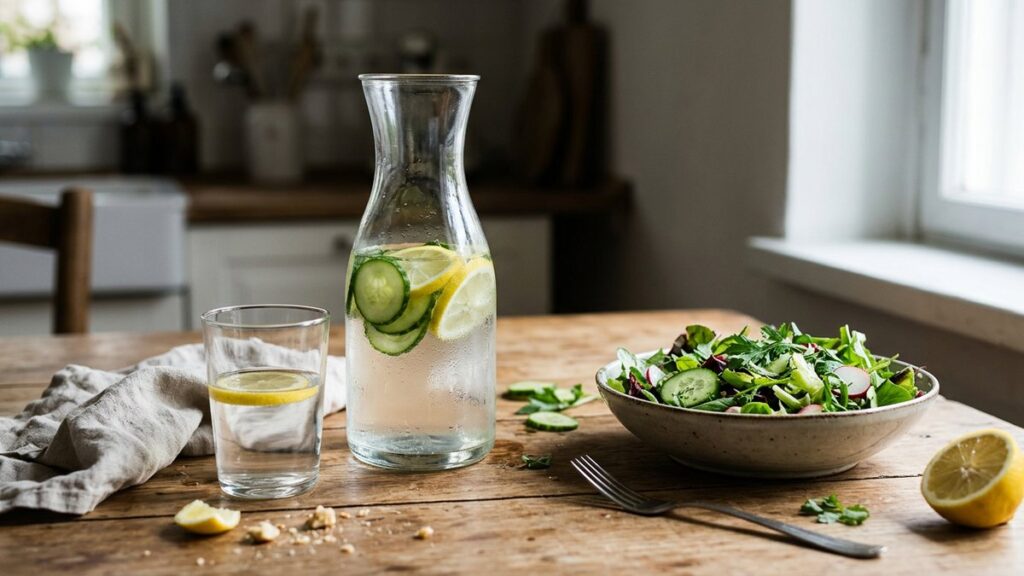
- Flavor it without sugar. Add cucumber, lemon or mint. Our cucumber water recipe takes five minutes.
- Keep water in sight. A filled bottle on your desk or in your bag makes the easy choice the default.
- Drink more on hot or active days. Sweat losses raise your needs.
- Eat water-rich foods. About 20% of total water usually comes from food, including fruits and vegetables.
- Let thirst guide you. You do not need to force down large amounts to lose weight. Thirst gets weaker with age, so older adults may do better drinking on a schedule, such as a glass of water with each meal and snack.
Water works best as part of a bigger plan. Our 15 tips for weight loss cover meals, sleep and activity, and you can browse more in our weight loss tips section.
Who should be careful with water intake
More water is not always better. Talk with your doctor before raising your intake if any of these apply to you.
- Heart failure: fluid can build up in the body and cause swelling, weight gain and shortness of breath. Your provider may tell you how much fluid to drink and ask you to weigh yourself every morning, explains MedlinePlus. Follow that limit, not general advice like this article.
- Kidney disease: people with chronic kidney disease may need to limit liquids because damaged kidneys cannot remove extra fluid, says the National Institute of Diabetes and Digestive and Kidney Diseases.
- Liver cirrhosis or diuretic medicines: both are linked to low blood sodium, so ask your doctor what fluid intake is right for you.
- Endurance exercise: drinking large amounts of plain water during long, hard exercise can lower blood sodium. For sports and other vigorous activity, MedlinePlus advises sports drinks with electrolytes to keep sodium in a healthy range.
Can you drink too much water?
Yes, though it is uncommon in healthy people. Healthy kidneys can get rid of about 0.7 liters of excess water an hour at most, notes the National Academies report. Drinking much faster than that for hours can dilute the sodium in your blood, a condition called hyponatremia.
Symptoms include headache, nausea, vomiting, confusion, fatigue, muscle cramps and seizures. Low blood sodium can be a life-threatening emergency, according to MedlinePlus. Heart failure, kidney disease, cirrhosis and diuretics are among its causes, which is why those groups need personal advice.
Frequently asked questions
Should I drink a gallon of water a day to lose weight?
A gallon is about 3.8 liters, more than the 2.7 liters of total water women are advised to get from all foods and drinks combined. The weight-loss trials above used about 2 cups before meals, and the best amount for weight loss is still unknown. If you try it, spread it through the day, because healthy kidneys clear only about 0.7 liters an hour. Do not try it if you have heart failure or kidney disease.
Is it better to drink water before or after meals for weight loss?
Before. The weight-loss trials gave 500 mL of water before each main meal. Lab tests that gave water 30 minutes before eating found that older adults ate less afterward. The effect was weaker or absent in young adults.
How much water a day is enough?
For most healthy adults, about 2.7 liters of total water a day for women and 3.7 liters for men, from all foods and drinks. Drinks usually supply about 80% of that, and most healthy people get enough by drinking with meals and when thirsty. Thirst gets weaker with age, so older adults may do better drinking on a schedule, such as a glass of water with each meal and snack.
Do coffee and tea count toward my water intake?
Yes. The National Academies report says caffeinated drinks contribute to total water intake, and any extra urination they cause appears to be short-lived. Choose them unsweetened if you are trying to lose weight.
Can drinking too much water be dangerous?
It can, but it is rare in healthy people. Drinking far more than your kidneys can clear, which is about 0.7 liters an hour, can cause low blood sodium. Symptoms include headache, nausea, confusion and muscle cramps. Seek care right away if these appear after heavy drinking.
Will drinking more water help me lose belly fat?
Not directly. No drink targets belly fat. Water can help you eat a little less and cut calories from sugary drinks, which lowers total body fat over time, including around your waist.
Sources
- Dietary Reference Intakes for Water, Potassium, Sodium, Chloride, and Sulfate: Summary, Institute of Medicine, National Academies Press (Internet Archive copy, captured August 28, 2025)
- How Much Water Do You Need?, Harvard T.H. Chan School of Public Health, The Nutrition Source
- Water consumption increases weight loss during a hypocaloric diet intervention in middle-aged and older adults (Dennis et al., 2010), Obesity
- Water intake, hydration, and weight management: the glass is half-full! (Davy et al., 2025), Physiology & Behavior
- Water-induced thermogenesis and fat oxidation: a reassessment (Charrière et al., 2015), Nutrition & Diabetes
- Heart failure: fluids and diuretics, MedlinePlus, U.S. National Library of Medicine
- Healthy Eating for Adults with Chronic Kidney Disease, National Institute of Diabetes and Digestive and Kidney Diseases
- Low blood sodium, MedlinePlus, U.S. National Library of Medicine