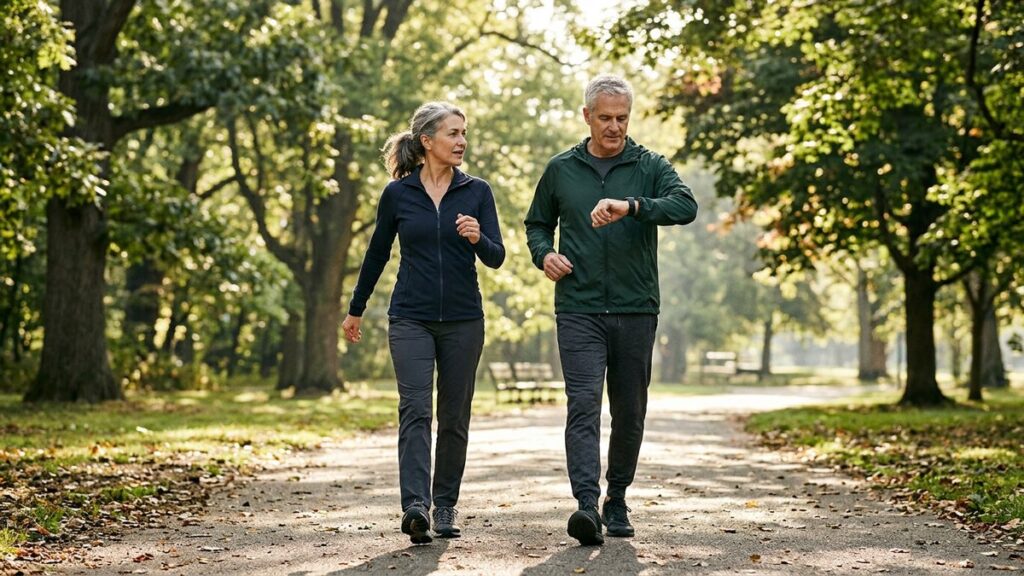
Japanese walking is interval walking: you alternate 3 minutes of easy walking with 3 minutes of brisk walking, repeat the pair five times for 30 minutes, and do it at least 4 days a week. Researchers at Shinshu University in Japan developed the method, which they call interval walking training. In their trials it improved fitness and leg strength and lowered blood pressure more than steady walking, but changes in weight were usually modest.
Key takeaways
- The original protocol is at least five rounds of 3 minutes slow (about 40% of a person’s peak aerobic capacity) and 3 minutes fast (70% or more), at least 4 days a week.
- In a 5-month trial of 246 adults with an average age of 63, interval walkers gained 13% to 17% in thigh strength and 8% to 9% in peak aerobic capacity. Those gains, and the drop in systolic blood pressure, were bigger than in steady walkers.
- In a study of 679 adults, fitness gains rose with brisk walking time up to about 50 minutes a week, then leveled off. Slow or total walking time did not predict the gains.
- Weight loss is not the main payoff. One small trial saw 4.3 kg (about 9.5 pounds) of loss, but it prescribed 60-minute sessions five days a week. A 20-week study with a 60-minute weekly brisk target found no significant change in body composition.
- If you are inactive and have heart, metabolic or kidney disease, or symptoms of them, talk to your doctor before the brisk intervals.
What is Japanese walking?
“Japanese walking” is the social media name for interval walking training, or IWT. Hiroshi Nose and colleagues at Shinshu University Graduate School of Medicine in Matsumoto, Japan, developed it for middle-aged and older adults.
They wrote that no long-term program for this age group was both easy to stick with and effective. So they built one around interval walking, backed by a computer network that needed little staff support (Masuki et al., Exercise and Sport Sciences Reviews, 2017).
In their best-known trial, people walked slowly for 3 minutes at 40% of their peak aerobic capacity, then fast for 3 minutes at more than 70%. They repeated this at least five times a day, on 4 or more days a week (Nemoto et al., Mayo Clinic Proceedings, 2007).
Peak aerobic capacity is the most oxygen your body can use at full effort. The researchers tested each person’s fitness to set personal paces, and in the 2007 trial participants wore an accelerometer that tracked how hard they walked.
How to do Japanese walking: 3 minutes fast, 3 minutes slow
- Pick a safe route or a treadmill. Flat ground is easiest at first. Wear supportive walking shoes.
- Set an interval timer for 3-minute blocks. A timer app or a sports watch with interval alerts works well.
- Start with 3 minutes easy. In the original protocol each set begins with the slow part, so it doubles as your warm-up.
- Walk briskly for 3 minutes. Lengthen your stride, swing your arms and aim for about 7 out of 10 effort.
- Slow down for 3 minutes. Let your breathing settle while you keep moving.
- Repeat until you have done five brisk and five easy blocks. That is 30 minutes of intervals.
- Cool down for 3 to 5 minutes. Finish with easy walking so your heart rate and breathing settle gradually, as the Physical Activity Guidelines advise.
- Do it on at least 4 days a week and note your brisk minutes. Those minutes matter most.
How fast is “brisk”?
The studies set each person’s speeds from fitness tests. At home, use effort and breathing. The Physical Activity Guidelines for Americans describe a 0-to-10 effort scale: moderate effort is a 5 or 6, and vigorous effort starts at 7 or 8.
Their talk test says that during moderate activity you can talk but not sing, and during vigorous activity you can’t say more than a few words without pausing for breath (Physical Activity Guidelines for Americans, 2nd edition).
| Phase | Target in the Shinshu studies | Practical check at home |
|---|---|---|
| Easy, 3 minutes | About 40% of peak aerobic capacity | A relaxed recovery pace. You could chat in full sentences. |
| Brisk, 3 minutes | 70% of peak aerobic capacity or more | About 7 out of 10. You can say only a few words before you pause for breath. |
Treat 7 out of 10 as a stand-in for the 70% target, not an exact match. The guidelines also say older or less fit adults should judge effort against their own fitness, since the same fast walk can feel vigorous to one person and easy to another.
Japanese walking benefits: what the research found
| Study | Who took part | Plan | Main results |
|---|---|---|---|
| Nemoto et al., 2007 | 246 adults, average age 63 | 5 months of interval walking, steady walking (about 50% of capacity, 8,000+ steps on 4+ days a week) or no training | Interval group: thigh strength up 13% to 17%, peak aerobic capacity up 8% to 9%, all more than the steady group. Bigger drop in resting systolic blood pressure. |
| Masuki et al., 2019 | 679 adults, average age 65 | 5 months of interval walking | Estimated peak aerobic capacity up 14% and a lifestyle-disease risk score down 17% on average. Gains plateaued above about 50 brisk minutes a week. |
| Karstoft et al., 2013 | 32 adults with type 2 diabetes in Denmark | 4 months: interval walking or steady walking, 60 minutes 5 times a week with matched energy use, or no training | Interval group: aerobic fitness up 16%, weight down 4.3 kg, fat mass down 3.1 kg, less visceral fat and lower peak blood sugar on continuous glucose monitoring. Steady walkers had no change in fitness or body composition. |
| Kitajima et al., 2023 | 51 adults with type 2 diabetes | 20 weeks of interval walking, aiming for 60 brisk minutes a week | 39% reached the target. No significant change in HbA1c or body composition. HDL (“good”) cholesterol rose. Peak aerobic capacity rose 10% in those who hit the target. |
Brisk minutes drive the results
In the 679-person study, participants averaged 88 minutes of fast walking a week. Both fitness and the risk score improved as weekly fast walking rose to about 50 minutes, then flattened out. Slow walking time and total walking time did not predict improvement (Masuki et al., Mayo Clinic Proceedings, 2019).
In plain terms, the brisk blocks do the work. The easy blocks let you repeat them.
Sticking with it is the hard part
In the 2007 trial, only 42 of the 87 people in the interval group met the full training target (Nemoto et al.). In the 2023 diabetes study, 39% reached the brisk-minute goal (Kitajima et al., PLoS One, 2023). Plan for a routine you can keep, not a perfect one.
Japanese walking for weight loss: what to expect
Japanese walking can help, but expect fitness and blood pressure benefits before big changes on the scale.
- The biggest weight result came with a lot of walking. The Danish trial’s 4.3 kg loss came with 60-minute sessions five times a week, or 300 minutes, while energy-matched steady walkers saw no change in body composition (Karstoft et al., Diabetes Care, 2013).
- The standard dose did less. With a target of 60 brisk minutes a week for 20 weeks, body composition did not change significantly (Kitajima et al.).
- Bigger weight goals take more activity and a diet change. The Physical Activity Guidelines say people who want to lose more than 5% of their body weight may need more than 300 minutes of moderate activity a week, and that combining calorie reduction with activity works best.
The standard 4-day plan gives you 60 brisk minutes a week. If those minutes are truly vigorous, the guidelines count each one as 2 moderate minutes, so the brisk blocks alone equal 120 minutes. A fifth session brings that to 150 minutes, the weekly minimum.
The Danish trial also found less visceral (deep belly) fat after interval walking, but it was one small trial. For the bigger picture, see our guide to whether walking burns belly fat.
The guidelines also stress that activity brings major health benefits whether or not your weight changes.
8-week Japanese walking plan
This plan builds to the study protocol by week 4. After that it focuses on pace and consistency. It follows the guidelines’ advice that inactive people should “start low and go slow.”
| Week | Walks per week | Sets per walk (3 min easy + 3 min brisk) | Interval minutes per walk (plus 3–5 min cool-down) | Brisk minutes per week | Brisk effort (0–10) | Focus |
|---|---|---|---|---|---|---|
| 1 | 3 | 3 | 18 | 27 | 5–6 | Learn the two paces |
| 2 | 3 | 4 | 24 | 36 | 6 | Keep the brisk pace steady for all 3 minutes |
| 3 | 4 | 4 | 24 | 48 | 6–7 | Add a fourth walking day |
| 4 | 4 | 5 | 30 | 60 | 7 | Full study protocol |
| 5 | 4 | 5 | 30 | 60 | 7 | Hold the protocol; add 2 days of muscle-strengthening work |
| 6 | 4 | 5 | 30 | 60 | 7 | Try a gentle hill during one or two brisk blocks |
| 7 | 5 | 5 | 30 | 75 | 7 | Add a fifth day; 75 vigorous minutes count as 150 moderate |
| 8 | 5 | 5 | 30 | 75 | 7 | Retest: time yourself on a set route and compare with week 1 |
If 3 brisk minutes feel too hard at first, slow the brisk pace rather than skipping sets. If you miss a week, repeat the previous week instead of jumping ahead. The guidelines recommend muscle-strengthening activities on 2 or more days a week for all adults, which is why week 5 adds them.
Japanese walking vs other cardio
- Versus steady walking: in the 2007 trial, interval walkers gained more strength and aerobic capacity than steady walkers (Nemoto et al.).
- Versus HIIT: Japanese walking is gentler, with longer intervals and no running or jumping. If you want harder, shorter sessions, see our guide to HIIT workouts for weight loss.
- Versus other cardio: compare it with incline walking, rowing and more in our list of cardio exercises for weight loss.
The two large Shinshu trials studied adults in their 60s, so the evidence fits older adults well. For motivation, read our weight loss success stories over 50.
Who should check with a doctor first
Walking is safe for most people, but the brisk blocks are meant to feel hard. The American College of Sports Medicine’s screening model looks at three things: how active you are now, whether you have known heart, metabolic or kidney disease or signs or symptoms of them, and how hard you plan to exercise.
It also notes that exercise-related heart events are often preceded by warning signs (Riebe et al., Medicine & Science in Sports & Exercise, 2015). Talk with your doctor before you start if:
- You are currently inactive and have heart disease, diabetes, kidney disease or another chronic condition.
- You take insulin or a sulfonylurea for diabetes. Extra activity can lower blood sugar for up to 24 hours, so ask your doctor whether to check your levels or adjust your medicine.
- You have had chest pain or pressure, unusual shortness of breath, dizziness or fainting with effort.
- You are pregnant. The Physical Activity Guidelines say pregnant women should be under the care of a health care provider who can advise on activity.
- You have joint pain, a recent injury or surgery, or balance problems that make fast walking risky.
During any session, stop and get medical help if you develop chest pain, severe breathlessness or feel faint.
Frequently asked questions
Does Japanese walking help you lose weight?
It can help a little, but it is mainly a fitness and blood pressure workout. The biggest weight loss in a trial came with 300 minutes of walking a week, far more than the standard plan. Pair it with a calorie deficit if weight loss is your goal.
Is Japanese walking better than 10,000 steps a day?
No study has compared the two directly. In the original 2007 trial, interval walking beat a steady routine of 8,000 or more steps a day for gains in leg strength and aerobic capacity. Claims that it is many times better than 10,000 steps go beyond the evidence.
Can I do Japanese walking on a treadmill?
Yes. Change the speed every 3 minutes, or raise the incline during the brisk blocks if you can’t walk faster comfortably. Use the same effort and talk-test checks you would use outdoors.
How long does it take to see results?
The trials measured fitness and blood pressure after 4 to 5 months of training at least 4 days a week, so plan on months, not weeks. To track your own progress, time yourself on a set route every few weeks, as week 8 of the plan suggests.
Is Japanese walking good for seniors?
The large trials enrolled middle-aged and older adults with average ages of 63 to 65. Older adults should set the brisk pace by their own effort level and check with a doctor first if they have heart, metabolic or kidney disease, symptoms of them, or balance problems.
Find more workouts in our exercise and fitness section.
Sources
- Effects of high-intensity interval walking training on physical fitness and blood pressure in middle-aged and older people, Nemoto K et al., Mayo Clinic Proceedings, 2007
- High-intensity walking time is a key determinant to increase physical fitness and improve health outcomes after interval walking training in middle-aged and older people, Masuki S et al., Mayo Clinic Proceedings, 2019
- The effects of free-living interval-walking training on glycemic control, body composition, and physical fitness in type 2 diabetic patients, Karstoft K et al., Diabetes Care, 2013 (via PubMed Central)
- Interval walking training in type 2 diabetes: a pilot study to evaluate the applicability as exercise therapy, Kitajima K et al., PLoS One, 2023 (via PubMed Central)
- Physical Activity Guidelines for Americans, 2nd edition, US Department of Health and Human Services
- Interval walking training can increase physical fitness in middle-aged and older people, Masuki S et al., Exercise and Sport Sciences Reviews, 2017
- Updating ACSM’s recommendations for exercise preparticipation health screening, Riebe D et al., Medicine & Science in Sports & Exercise, 2015
- Low Blood Glucose (Hypoglycemia), National Institute of Diabetes and Digestive and Kidney Diseases