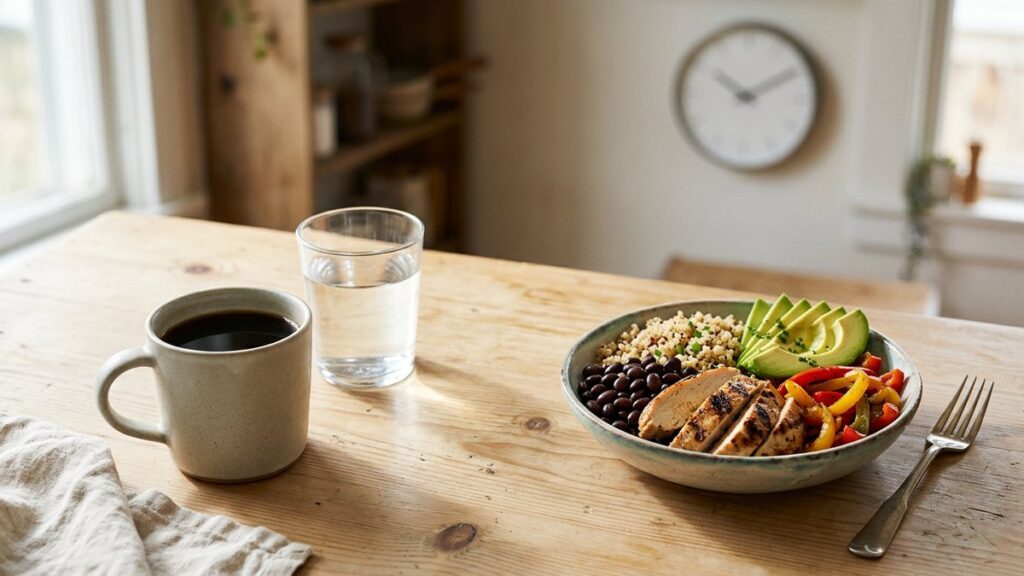
16:8 intermittent fasting means you eat all your food within an 8-hour window, such as noon to 8 p.m., and have nothing with calories for the other 16 hours. In clinical trials it led to modest weight loss when people ended up eating less, and the results were similar to standard calorie cutting. Think of it as a scheduling tool, not a fat-burning switch: what you eat inside the window still matters.
Key takeaways
- Pick any 8 hours in a row that fit your day. Noon to 8 p.m. is the window used in two US trials.
- In a 12-month trial, adults who ate from noon to 8 p.m. without counting calories for 6 months, then within a 10-hour window for 6 more, lost about 4.6 kg (10 pounds) more than a control group. That was about the same as a group that cut calories by 25%.
- When the shorter window did not lead people to eat less, it did little. A 12-week trial found no meaningful difference from eating three meals a day.
- During the fast, stick to water, black coffee, plain tea and other drinks with zero calories.
- Skip it if you are pregnant or breastfeeding, under 18 or have a history of an eating disorder, and fast on insulin or a sulfonylurea only with your care team.
How 16:8 intermittent fasting works
16:8 is a form of time-restricted eating. The 16 is the number of hours you fast, and the 8 is the number of hours you eat. Unlike calorie counting, the main rule is about the clock, not the plate.
In trials without calorie targets, people could eat whatever they wanted during the window. The weight loss seems to come mainly from eating less. Researchers note that when people with obesity limit eating to 6 to 8 hours a day, they tend to take in 350 to 500 fewer calories without trying, and the time-restricted group in a 12-month trial in Chicago ate about 425 fewer calories a day.
That is also why 16:8 does not work for everyone: if a long fast leads to a much bigger dinner, the calorie gap closes. For other styles, such as 5:2 and alternate-day fasting, see our guide to intermittent fasting results.
16:8 intermittent fasting schedule options
Any 8 consecutive hours count. These common windows include the ones researchers have tested.
| Eating window | Fasting window | Works well if you | Keep in mind |
|---|---|---|---|
| 7 a.m. to 3 p.m. | 3 p.m. to 7 a.m. | Wake early and like a big breakfast | Tested alongside calorie cutting in a 14-week trial; hard with evening plans |
| 8 a.m. to 4 p.m. | 4 p.m. to 8 a.m. | Work days and can eat an early dinner | Used with calorie limits in a 12-month trial |
| 10 a.m. to 6 p.m. | 6 p.m. to 10 a.m. | Prefer a late breakfast and an early dinner | Dinner out with friends may run past 6 p.m. |
| Noon to 8 p.m. | 8 p.m. to noon | Skip breakfast easily and want dinner with family | The window used in two US trials without calorie counting |
Is an early window better?
Possibly, but the evidence is mixed. In a 14-week trial of 90 adults with obesity, everyone got the same calorie-cutting advice.
People who ate only between 7 a.m. and 3 p.m. lost 2.3 kg more than people who spread their eating over 12 or more hours. The researchers said the effect was like cutting an extra 214 calories a day. Their body fat loss was not significantly different, though.
That trial compared an early 8-hour window with a long eating day, not early and late 8-hour windows. A 2025 trial in Spain did compare them.
It assigned 197 adults with overweight or obesity to an early, late or self-chosen 8-hour window, or to usual care, all with Mediterranean diet advice, for 12 weeks. Deep belly (visceral) fat did not differ by window timing, and no window reduced it more than the diet advice alone.
Adherence was 85% to 88% in all three window groups. So the best window is the one you can keep. In the Chicago trial, people kept their eating window about 6 days out of 7 and still lost weight, so an occasional late dinner is fine.
How to start in four weeks
- Week 1: Stop eating after dinner and aim for a 12-hour overnight fast, such as 8 p.m. to 8 a.m.
- Week 2: Push your first meal later, or your last meal earlier, to reach 14 hours.
- Week 3: Reach 16 hours on most days. Plan your first meal around a protein food, as in the sample menu below.
- Week 4: Weigh yourself once a week at the same time. If nothing has changed after a few weeks, check your portions against your daily calorie needs for weight loss.
Night-shift workers were left out of the 12-month Chicago trial, so there is little evidence for them. If you work shifts, pick 8 waking hours you can repeat on most days and check with your doctor first.
What breaks a fast on 16:8?
Strictly speaking, anything with calories. In the Chicago trial and a trial of 4- and 6-hour eating windows, people were encouraged to drink plenty of water during the fast.
They could also have energy-free drinks such as black coffee, black tea and diet soda.
| Item | OK during the 16-hour fast? | Why |
|---|---|---|
| Water or plain sparkling water | Yes | No calories; trials encouraged plenty of water |
| Black coffee, plain tea, unsweetened herbal tea | Yes | Energy-free drinks were allowed in trials |
| Diet soda | Yes, in moderation | Allowed in two trials; one limited it to two a day |
| Coffee with milk, cream, sugar or syrup | No, strictly | Adds calories; no trial tested “just a splash” |
| Juice, smoothies, protein shakes, collagen powder, bone broth | No | All contain calories |
| Gum, mints, flavored waters | Check the label | If it lists calories, it is not energy-free |
| Prescription medicine | Take as prescribed | If a medicine must be taken with food, talk to your prescriber before you pick a window |
What to eat on 16:8: a sample menu
The clock does not fix food quality. In the TREAT trial, a subgroup on 16:8 lost 1.7 kg on average, and about 1.1 kg of that (roughly 65%) was lean mass rather than fat.
The authors noted that lean tissue usually makes up 20% to 30% of weight lost, and they stressed eating enough protein while following time-restricted eating.
So build each meal around a protein food, then add vegetables, fruit, whole grains and some healthy fat. Here is one example day for a noon to 8 p.m. window.
| Time | Meal | Example |
|---|---|---|
| Morning | Fasting | Water, black coffee or plain tea |
| 12:00 p.m. | Lunch | Grain bowl with brown rice, black beans, grilled chicken or tofu, peppers, salsa and a few slices of avocado |
| 3:30 p.m. | Snack | Plain Greek yogurt with berries and a small handful of walnuts |
| 7:00 p.m. | Dinner | Baked salmon or a lentil stew, roasted broccoli, a small baked potato and a side salad with olive oil |
| 7:45 p.m. | Optional | A piece of fruit |
| After 8:00 p.m. | Fasting | Water or herbal tea |
If you prefer an early window, start with a protein-rich breakfast at 8 a.m.; our list of breakfast ideas for weight loss has options. For filling dinners that fit a calorie budget, browse these low-calorie meals. Portions depend on your calorie needs.
16:8 intermittent fasting results: what trials show
| Trial | Who and what | Length | Result |
|---|---|---|---|
| TREAT, JAMA Internal Medicine, 2020 | 116 adults with overweight or obesity; noon to 8 p.m. with no other diet advice, compared with three meals a day | 12 weeks | 0.94 kg lost on 16:8 vs 0.68 kg with three meals; the difference was not significant |
| Annals of Internal Medicine, 2023 | 90 adults with obesity; noon to 8 p.m. without calorie counting for 6 months, then a 10-hour window, compared with a 25% calorie cut and a control group; both diet groups met with a dietitian | 12 months | About 4.6 kg more weight loss than control with time-restricted eating and 5.4 kg with calorie cutting; the two diets were not significantly different |
| New England Journal of Medicine, 2022 | Adults with obesity; 8 a.m. to 4 p.m. plus a calorie limit, compared with the same calorie limit at any time | 12 months | About 18 pounds vs 14 pounds; not significantly different |
| JAMA Internal Medicine, 2022 | 90 adults with obesity; 7 a.m. to 3 p.m. plus calorie cutting, compared with a 12-hour-plus window and the same advice | 14 weeks | 2.3 kg more weight loss with the early window; body fat difference not significant |
The New England Journal trial is summarized by the Harvard T.H. Chan School of Public Health, which concludes that it is unclear whether intermittent fasting beats other weight-loss methods.
A large 2025 BMJ review of 99 trials with 6,582 adults agrees. Every fasting style and standard calorie restriction led to more weight loss than unrestricted eating. Time-restricted eating did not beat continuous calorie restriction; only alternate-day fasting showed a small edge.
Expect modest, gradual results. Researchers behind the 4- and 6-hour trial noted that short time-restricted eating trials have reported weight loss of about 3% to 4% over a few months.
Over a year, the time-restricted group in the Chicago trial lost about 4.9% more than the control group. In practice, the group’s average eating window at month 12 was still just under 8 hours.
16:8 intermittent fasting benefits beyond weight
The evidence here is mixed. In the 14-week early-window trial, diastolic blood pressure (the bottom number) fell about 4 mm Hg more than in the comparison group, and mood scores, including fatigue and low mood, improved.
TREAT found no significant changes in its other secondary outcomes, which included fasting glucose, insulin and HbA1c. In the Chicago trial, blood pressure, cholesterol, fasting glucose and HbA1c did not differ from the control group at 12 months, though insulin sensitivity improved.
16:8 vs 18:6: is a longer fast better?
Not clearly. The best-known head-to-head trial compared a 6-hour window (1 to 7 p.m., often called 18:6) with a 4-hour window (3 to 7 p.m.).
After 8 weeks, both groups lost about 3% of their body weight compared with controls and ate about 550 fewer calories a day. The shorter window added nothing. We could not find a large trial that tested 16:8 against 18:6 directly.
| Schedule | Example window | What the evidence shows |
|---|---|---|
| 14:10 | 10 a.m. to 8 p.m. | Used to maintain weight after 6 months of 16:8 in the 12-month Chicago trial |
| 16:8 | Noon to 8 p.m. | The most studied; similar to calorie restriction over 12 months when followed by a 10-hour window |
| 18:6 | 1 to 7 p.m. | About 3% weight loss in 8 weeks vs controls |
| 20:4 | 3 to 7 p.m. | No more weight loss than 18:6 in the same 8-week trial |
If 16:8 is working, there is no strong evidence that a longer daily fast adds more weight loss. If it feels hard, a 10-hour window may be easier to keep, but treat it as a way to hold your weight: the Chicago researchers used it for maintenance because 10-hour windows had not led to weight loss in their earlier trials.
Is 16:8 safe? Who should avoid it
For most adults without the conditions below, 16:8 appeared safe in trials lasting up to a year. The Chicago trial reported no serious adverse events.
Side effects in the first few weeks
In the trial of 4- and 6-hour eating windows, mild dizziness, nausea, headaches and diarrhea peaked in week 2 and were gone by week 3. There were no serious adverse events. Constipation and dry mouth also showed up in week 2 and lasted through some or most of the 8-week trial.
The same researchers note that earlier trials of 8- and 10-hour windows found no change in nausea, constipation, diarrhea, headaches, fatigue or irritability after 12 weeks.
The Harvard review adds a behavioral caution. Long stretches without food may lead to overeating when you eat again, or to a fixation on food. If you feel faint, or symptoms last beyond the first few weeks, stop and talk to your doctor.
Who should not try 16:8
The Harvard review lists groups who should abstain from intermittent fasting: people who are pregnant or breastfeeding, adolescents and others who are still growing, people with eating disorders that involve self-restriction such as anorexia or bulimia, people with diabetes and people taking medicines that must be taken with food.
Diabetes medicine is the most urgent concern. A clinical review on fasting with diabetes says the main immediate risk is low blood sugar in people taking insulin or sulfonylureas, such as glipizide or glyburide. It says people with diabetes can fast safely when their care team supervises, with regular glucose checks and medicine changes as needed.
Older adults have less evidence to go on. The Harvard review lists whether intermittent fasting is safe for older people among its unanswered questions, so check with your doctor first.
Do not try 16:8 if you are pregnant or breastfeeding, are under 18 or still growing, or have a history of an eating disorder such as anorexia or bulimia.
Talk to your doctor first if you have diabetes (fasting on insulin or a sulfonylurea needs your care team’s supervision and glucose checks), take a medicine that must be taken with food, or are an older adult.
For more structured eating approaches, browse our diet plans.
Frequently asked questions
How much weight can you lose with 16:8 intermittent fasting?
It depends mostly on whether the window helps you eat less. In the trials above, losses ranged from under 1 kg in 12 weeks, when people did not eat less, to about 4.6 kg (10 pounds) more than a control group over 12 months (6 months of 16:8, then 6 months of a 10-hour window). Short time-restricted eating trials have reported about 3% to 4% of body weight over a few months.
Can I drink coffee during the 16-hour fast?
Yes. Black coffee and plain tea were allowed during the fasting hours in trials. Milk, cream, sugar and syrups add calories, so strictly speaking they end the fast.
Do I have to count calories on 16:8?
Not necessarily. In a 12-month trial, people who ate from noon to 8 p.m. for 6 months, then widened to 10 hours, lost about as much as people who cut calories by 25%, without counting calories. If your weight has not moved after a few weeks, check your portions.
Is it better to skip breakfast or dinner?
Early windows have some support: a 14-week trial found more weight loss with a 7 a.m. to 3 p.m. window than with a 12-hour eating day. That trial did not test a late 8-hour window. A 2025 trial of 197 adults that did found no difference in deep belly fat between early, late and self-chosen 8-hour windows, so choose the window you can keep.
Is 16:8 safe for women?
Women made up most participants in several of the trials cited here, including 80% of the early-eating trial and 82% of the 12-month Chicago trial, which reported no serious adverse events. That trial excluded women who were pregnant, trying to conceive, perimenopausal or had irregular periods, so there is little evidence for those groups. Women who are pregnant, breastfeeding or have a history of an eating disorder should not try 16:8.
Sources
- Lowe DA, et al. Effects of time-restricted eating on weight loss and other metabolic parameters in women and men with overweight and obesity: the TREAT randomized clinical trial. JAMA Internal Medicine, 2020.
- Lin S, et al. Time-restricted eating without calorie counting for weight loss in a racially diverse population: a randomized controlled trial. Annals of Internal Medicine, 2023.
- Harvard T.H. Chan School of Public Health, The Nutrition Source. Diet Review: Intermittent Fasting for Weight Loss.
- Jamshed H, et al. Effectiveness of early time-restricted eating for weight loss, fat loss, and cardiometabolic health in adults with obesity: a randomized clinical trial. JAMA Internal Medicine, 2022.
- Cienfuegos S, et al. Effects of 4- and 6-h time-restricted feeding on weight and cardiometabolic health: a randomized controlled trial in adults with obesity. Cell Metabolism, 2020.
- Semnani-Azad Z, et al. Intermittent fasting strategies and their effects on body weight and other cardiometabolic risk factors: systematic review and network meta-analysis of randomised clinical trials. BMJ, 2025.
- Grajower MM, Horne BD. Clinical management of intermittent fasting in patients with diabetes mellitus. Nutrients, 2019.
- Dote-Montero M, et al. Effects of early, late and self-selected time-restricted eating on visceral adipose tissue and cardiometabolic health in participants with overweight or obesity: a randomized controlled trial. Nature Medicine, 2025.