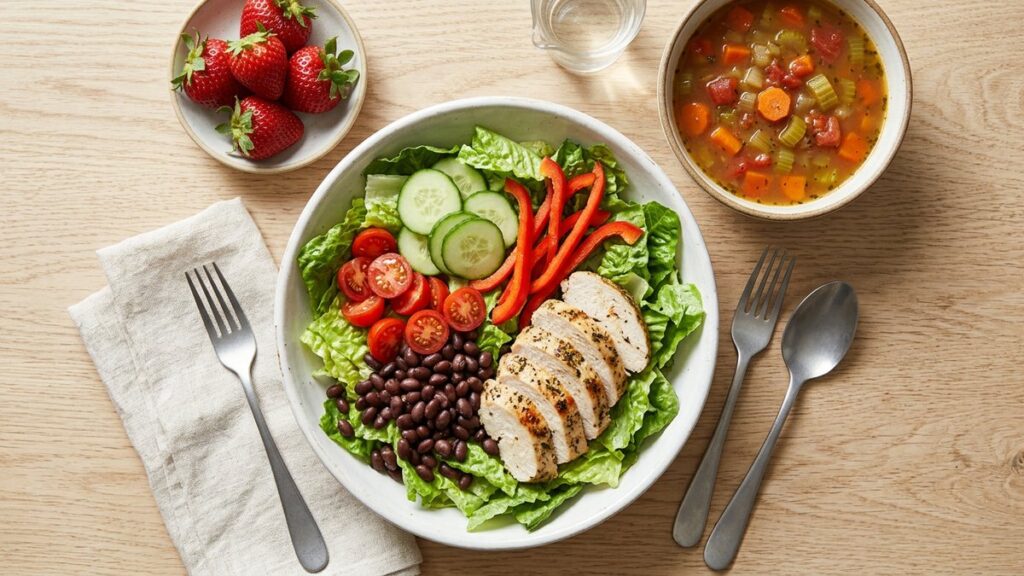
Volume eating means building meals around foods that give you a lot to eat for few calories, such as vegetables, fruit, broth-based soups and lean protein. People tend to eat a fairly steady amount of food by weight, so filling the plate with these foods lets you eat a full portion while taking in fewer calories. In a year-long Penn State trial, women told to eat more water-rich foods lost more weight than women told to cut fat and watch portion sizes, and they felt less hungry.
Key takeaways
- Volume eating works by lowering energy density, the calories in each gram of food. Water adds weight with no calories, and fat adds the most.
- In a 1-year trial, women who cut fat and ate more fruit and vegetables lost 7.9 kg (17.4 pounds), versus 6.4 kg (14.1 pounds) for women who cut fat and were taught to limit portions. They also ate more food and reported less hunger.
- Swap, don’t add. Bulky foods cut calories only when they replace denser ones.
- Every meal still needs a protein source and a small, measured amount of fat.
What is volume eating?
Volume eating is a way of choosing foods by their energy density, the number of calories in one gram of food. According to a review by Penn State nutrition scientist Barbara Rolls, foods range from 0 to 9 calories per gram.
Fat has 9 calories per gram, while carbohydrate and protein have 4. Water lowers energy density because it adds weight but no calories. In USDA FoodData Central, 100 grams of raw cucumber has 15 calories, and the same weight of plain potato chips has 532.
Does volume eating work? What the research shows
Small changes in energy density add up. In the Rolls review’s example, an adult who eats 1,200 grams of food a day at 1.8 calories per gram takes in 2,160 calories. Lower that average by 0.1 calories per gram, and the same weight of food delivers 2,040 calories, 120 fewer a day.
The year-long weight loss trial
The best long-term test is a 1-year randomized trial published in 2007. Researchers assigned 97 women with obesity to cut fat and choose appropriate portion sizes, or to cut fat and eat more water-rich foods, especially fruit and vegetables. Neither group got a calorie target.
Among the 71 women who finished the year, the fruit-and-vegetable group lost 7.9 kg (17.4 pounds) and the reduced-fat, portion-control group lost 6.4 kg (14.1 pounds). Rolls’ review notes the fruit-and-vegetable group reported eating about 25% more food and feeling less hungry. Eating more of the right foods beat eating less food.
The review also describes an analysis of 658 adults in PREMIER, a blood pressure lifestyle trial. After six months, people who cut energy density the most lost about 13 pounds, versus 9 pounds for a modest cut and 5 pounds for little or no change. Because people chose how much to change, this shows a link rather than proof.
What the satiety index adds
In the 1995 satiety index study by Holt and colleagues, volunteers ate 240-calorie portions of common foods. As a 2018 paper in Nutrients summarizes, the lower a food’s energy density, the more filling it was. Potatoes scored more than three times higher than white bread, and energy-dense snacks and sweets were among the least filling.
What the research doesn’t show
Most energy density studies are short lab tests, and the year-long trial enrolled women with obesity who met regularly with dietitians. Volume eating doesn’t cancel out calories. It makes a smaller calorie budget easier to live with.
Drinks are not soup, either: the Rolls review notes that soda did little for fullness in some studies.
Volume eating foods: calories per 100 grams
These figures come from USDA FoodData Central (SR Legacy entries), as eaten: raw unless the food says cooked. The last column shows how many grams you get for 100 calories, the easiest way to see “volume.”
Very low energy density (under 60 calories per 100 g)
| Food | Calories per 100 g | Protein per 100 g | Grams in 100 calories |
|---|---|---|---|
| Vegetable broth, ready to serve | 5 | 0.2 g | 2,000 g |
| Celery, raw | 14 | 0.7 g | 714 g |
| Cucumber with peel, raw | 15 | 0.7 g | 667 g |
| Romaine lettuce, raw | 17 | 1.2 g | 588 g |
| Zucchini, raw | 17 | 1.2 g | 588 g |
| Tomatoes, raw | 18 | 0.9 g | 556 g |
| White mushrooms, raw | 22 | 3.1 g | 455 g |
| Spinach, raw | 23 | 2.9 g | 435 g |
| Cauliflower, raw | 25 | 1.9 g | 400 g |
| Spaghetti squash, cooked | 27 | 0.7 g | 370 g |
| Watermelon | 30 | 0.6 g | 333 g |
| Strawberries | 32 | 0.7 g | 313 g |
| Broccoli, raw | 34 | 2.8 g | 294 g |
| Apple with skin | 52 | 0.3 g | 192 g |
| Egg whites | 52 | 10.9 g | 192 g |
| Blueberries | 57 | 0.7 g | 175 g |
| Greek yogurt, plain, nonfat | 59 | 10.2 g | 169 g |
To check any figure, search the food name in FoodData Central and choose the SR Legacy entry.
Low energy density (60 to 150 calories per 100 g)
| Food | Calories per 100 g | Protein per 100 g | Grams in 100 calories |
|---|---|---|---|
| Oatmeal, cooked with water | 71 | 2.5 g | 141 g |
| Cottage cheese, 1% milkfat | 72 | 12.4 g | 139 g |
| Potatoes, boiled, no skin | 86 | 1.7 g | 116 g |
| Light tuna, canned in water | 86 | 19.4 g | 116 g |
| Shrimp, cooked | 99 | 24.0 g | 101 g |
| Cod, cooked | 105 | 22.8 g | 95 g |
| Lentils, boiled | 116 | 9.0 g | 86 g |
| Brown rice, long-grain, cooked | 123 | 2.7 g | 81 g |
| Black beans, boiled | 132 | 8.9 g | 76 g |
Medium energy density (150 to 400 calories per 100 g)
| Food | Calories per 100 g | Protein per 100 g | Grams in 100 calories |
|---|---|---|---|
| Pasta, cooked | 158 | 5.8 g | 63 g |
| Chicken breast, roasted, no skin | 165 | 31.0 g | 61 g |
| Salmon, farmed, cooked | 206 | 22.1 g | 49 g |
| White bread | 266 | 8.9 g | 38 g |
| Popcorn, air-popped | 387 | 12.9 g | 26 g |
High energy density (over 400 calories per 100 g)
| Food | Calories per 100 g | Protein per 100 g | Grams in 100 calories |
|---|---|---|---|
| Cheddar cheese | 403 | 22.9 g | 25 g |
| Butter croissant | 406 | 8.2 g | 25 g |
| Potato chips, plain | 532 | 6.4 g | 19 g |
| Almonds | 579 | 21.2 g | 17 g |
| Peanut butter, smooth | 598 | 22.2 g | 17 g |
| Olive oil | 884 | 0 g | 11 g |
High on this list doesn’t mean “never.” Salmon, nuts and olive oil are nutritious in measured portions.
For more produce ideas, see our list of low-carb vegetables and our guide to foods that help you lose weight, or browse all of our healthy eating guides.
Why popcorn counts as a volume food
Air-popped popcorn looks dense per 100 grams because it is mostly air. USDA lists one cup at 8 grams, so 3 cups carry about 93 calories. Judge airy foods by the cup, and go easy on butter and oil.
How to build a high-volume meal
- Start with lean protein. Chicken, fish, shrimp, eggs or egg whites, Greek yogurt, cottage cheese, tofu, beans or lentils all work.
- Fill half the plate with non-starchy vegetables. Greens, zucchini, peppers, mushrooms, tomatoes, cauliflower and broccoli add bulk for very few calories.
- Add a measured starch or whole fruit. Potatoes, oats, rice, pasta, beans or fruit should take about a quarter of the plate. In one Penn State study, a whole apple before lunch cut lunch calories by 15% compared with no snack and was more filling than applesauce or apple juice.
- Add fat on purpose, and measure it. One teaspoon of olive oil has 40 calories, and one tablespoon has 119. Measure oil, creamy dressing and cheese, even on a plate of vegetables.
- Cook water into the food. Soups, stews, chili and oatmeal made with water keep the volume high. In another Penn State study, a chicken and rice casserole cooked with 10 ounces of water into a soup cut lunch intake by 26%, compared with the casserole alone or with a glass of water. Our weight loss vegetable soup is an easy batch recipe.
- Open with soup or a lightly dressed salad. A low-calorie first course can lower how much you eat at the rest of the meal. Before a pasta main course, a bigger low-calorie salad worked better than a smaller one. A high-calorie salad raised intake.
- Swap instead of adding. Replace part of a dense food with a bulky one, such as half pasta and half zucchini, or popcorn instead of chips. Piling vegetables on top of a full portion doesn’t cut calories.
Volume eating recipes: 5 sample meals with calories
Each meal lands near 400 calories, with a protein source, plenty of produce and a measured fat. We calculated totals from USDA FoodData Central, using cooked weights for meat, fish, pasta and beans and raw weights for everything else. For more ideas, see our low-calorie meals.
1. Big veggie egg scramble (about 370 calories)
1 large egg plus 150 g egg whites (about 4½ whites), scrambled with 2 cups raw spinach (60 g), 1 heaping cup sliced mushrooms (80 g) and ½ cup chopped red bell pepper (75 g) in 1 teaspoon olive oil. Serve with 1 slice whole-wheat toast and 1 cup strawberries (150 g). About 33 g protein and 9 g fiber.
2. Berry oatmeal bowl (about 390 calories)
½ cup dry oats (40 g) cooked in water, topped with a 170 g container of plain nonfat Greek yogurt, ½ cup blueberries (75 g), a heaping ½ cup raspberries (75 g) and about 8 almonds (10 g). About 26 g protein and 12 g fiber.
3. Giant chicken salad (about 400 calories)
2½ cups shredded romaine (120 g), 1 cup sliced cucumber (100 g), ⅔ cup cherry tomatoes (100 g), ½ cup chopped red bell pepper (75 g), 100 g roasted chicken breast and ⅓ cup black beans (60 g). Dress with 2 teaspoons olive oil and vinegar to taste. About 40 g protein and 11 g fiber.
4. Half-and-half shrimp pasta (about 420 calories)
100 g cooked spaghetti (about ¾ cup) tossed with 200 g sliced zucchini, 120 g cooked shrimp (about 4 ounces), ½ cup marinara sauce (125 g) and a handful of spinach (40 g), all sautéed in 1 teaspoon olive oil. About 40 g protein and 7 g fiber.
5. Lentil vegetable soup (about 400 calories)
Simmer ¾ cup cooked lentils (150 g), 1 medium carrot (60 g), 1½ celery stalks (60 g), ⅓ cup chopped onion (50 g), ⅔ cup canned tomatoes (150 g) and 2 cups kale (40 g) in about 1½ cups vegetable broth (350 g) with 1 teaspoon olive oil. Serve with 1 slice whole-wheat toast. About 22 g protein and 22 g fiber.
Volume eating mistakes to avoid
Too little protein
Vegetables are bulky but low in protein: by our USDA calculation, 300 grams of raw broccoli has 102 calories and only about 8.5 grams of protein. A review in Advances in Nutrition found that higher protein intake helps preserve lean body and muscle mass during weight loss, and it recommends adequate but not excessive amounts.
Egg whites, nonfat Greek yogurt, cottage cheese, shrimp, cod and chicken breast fit volume eating well. Our list of low-calorie, high-protein foods has more options.
Too little fat
Your body needs some fat to absorb vitamins A, D, E and K, according to MedlinePlus. About 8 almonds (58 calories) or 30 grams of avocado (48 calories) adds fat without wrecking the volume.
Adding fiber too fast
Doubling your vegetables overnight can cause gas, bloating and cramps. MedlinePlus advises adding fiber gradually over a few weeks and drinking plenty of fluids.
Who should be careful with volume eating
- People with a history of an eating disorder. Hunting for the lowest-calorie food can feed restrictive habits. The National Institute of Mental Health notes that becoming fixated on weight loss or controlling food intake may be a sign of an eating disorder. Talk with your doctor or a therapist before starting any diet.
- People with digestive conditions. With IBS, inflammatory bowel disease or another gut condition, ask your care team how fast to add fiber.
- People who need more calories, not fewer. Pregnant or breastfeeding people, older adults with a small appetite and anyone recovering from illness may find bulky meals make it hard to eat enough.
- People on a medical diet or diabetes medicines. If you follow a diet for a health condition, or take insulin or other glucose-lowering medicines, check with your care team before big changes.
Frequently asked questions
What foods are best for volume eating?
The best volume eating foods are non-starchy vegetables, fruit, broth-based soups and lean proteins. Cucumber, celery, lettuce, zucchini, tomatoes and strawberries all have 32 calories or fewer per 100 grams. Egg whites, nonfat Greek yogurt, shrimp, cod and chicken breast add protein.
Can you lose weight with volume eating?
Yes, if it lowers the total calories you eat. In the Penn State trial, the water-rich-foods group lost the most weight without a calorie target. A week or two of tracking can still show where oils, dressings and snacks sneak in.
Is volume eating the same as the Volumetrics diet?
They rest on the same idea. Rolls co-wrote the 2000 book Volumetrics, and the year-long Penn State trial cites it for the portion advice given to the fruit-and-vegetable group. “Volume eating” is the social media term, and online versions vary.
Is volume eating healthy?
It can be, when it’s built on vegetables, fruit, whole grains, beans and lean protein, with some healthy fat. In the PREMIER analysis described by Rolls, lowering energy density went along with better overall diet quality. It is less healthy when it means very low calories or skipping protein and fat.
Sources
- Rolls BJ. The relationship between dietary energy density and energy intake. Physiology & Behavior, 2009.
- Ello-Martin JA, et al. Dietary energy density in the treatment of obesity: a year-long trial comparing 2 weight-loss diets. American Journal of Clinical Nutrition, 2007.
- Subjective satiety following meals incorporating rice, pasta and potato. Nutrients, 2018 (summarizes Holt et al., A satiety index of common foods, 1995).
- USDA FoodData Central, SR Legacy data. US Department of Agriculture.
- Cava E, Yeat NC, Mittendorfer B. Preserving healthy muscle during weight loss. Advances in Nutrition, 2017.
- Dietary fats explained. MedlinePlus, US National Library of Medicine.
- Dietary fiber. MedlinePlus, US National Library of Medicine.
- Eating disorders. National Institute of Mental Health.