Matcha weight loss claims go far beyond the evidence. Matcha is powdered whole-leaf green tea, so a cup has more catechins and caffeine than brewed green tea, but trials show the extra weight loss is too small to matter. Its real value for weight control is as a low-calorie drink, as long as you go easy on milk and syrup.
Key takeaways
- Matcha is made from shade-grown green tea leaves ground into powder. You drink the whole leaf, not just water steeped with leaves.
- One gram of matcha powder has about 19 to 44 mg of caffeine. A 2-gram serving can have 38 to 89 mg, compared with about 29 mg in an 8-ounce cup of brewed green tea.
- A small 12-week pilot study of matcha itself found no significant extra weight loss over diet alone. A 2012 Cochrane review of green tea trials found a small, statistically non-significant weight loss that was not likely to be clinically important.
- Most of the calories in a matcha latte come from milk and sweetener. Our table shows a range from about 55 to more than 200 calories.
- Drinking green tea has not been linked to liver injury, apart from rare cases, but concentrated green tea extracts have. Pills and gummies made from green tea extract are a different product from tea.
What is matcha?
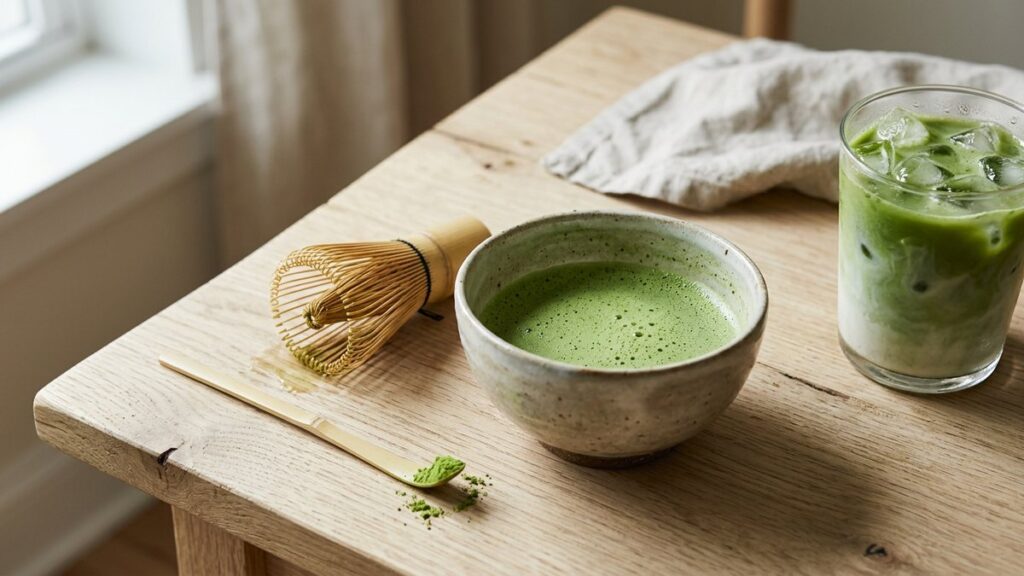
Matcha is a Japanese powdered green tea made from the same plant as all green tea, Camellia sinensis. According to a 2020 review of matcha’s chemistry in Molecules, growers shade the tea bushes for most of the growing period. Shading raises the leaves’ levels of theanine, caffeine and chlorophyll.
Chlorophyll gives matcha its bright green color, and theanine gives it a mild, savory taste with less bitterness. The leaves are then ground into a fine powder.
That powder is whisked into water or milk. Because you drink the ground leaf, you take in compounds that would stay behind in a tea bag.
Matcha vs green tea
| Feature | Matcha | Brewed green tea |
|---|---|---|
| What you drink | Whole leaf, ground and whisked in | Water steeped with leaves; leaves are removed |
| Caffeine | About 19 to 44 mg per gram of powder; 38 to 89 mg in a 2-gram serving | About 29 mg in an 8-ounce cup |
| Catechins (antioxidants) | Higher per cup, since you consume the powdered leaf; varies by grade and brand | Lower per cup; much stays in the leaves |
| Calories, plain | Check the tin’s label | About 2 per cup |
Caffeine ranges for matcha and dry green tea leaves come from the Molecules review: 18.9 to 44.4 mg per gram for matcha, compared with 11.3 to 24.67 mg per gram for other green tea leaves. Brewed tea and coffee values come from USDA FoodData Central (brewed green tea, 12 mg of caffeine per 100 grams; brewed coffee, 40 mg per 100 grams).
On antioxidants, the same review notes that tea made from powder had more polyphenols than tea made by steeping leaves. It also flags one analysis that found lower polyphenol levels in matcha leaves than in other green teas, possibly because of shading. In short, matcha gives you more of the leaf, but quality varies.
Matcha weight loss: what the research shows
Studies of matcha itself
Few human studies have tested matcha itself, and they are small. In a 12-week pilot study in Jordan, 40 people with overweight or obesity followed a low-calorie diet, and one group also drank matcha once a day.
Both groups lost weight, but body weight and body composition were not significantly different between the groups at the end. The study was not randomized, and 34 people finished it.
In a second, crossover study, 13 women drank matcha the day before and two hours before a 30-minute brisk walk. They burned slightly more fat during the walk than without matcha: 0.35 vs 0.31 grams per minute. The authors warned that this effect should not be overstated for weight loss.
Larger trials of green tea
Larger trials have tested green tea drinks and extracts, which contain the same catechins and caffeine. The strongest summary is a 2012 Cochrane review of green tea for weight loss. It included trials lasting 12 to 13 weeks in adults with overweight or obesity:
- Six trials outside Japan, with 532 people, found an average difference of just 0.04 kg (less than a tenth of a pound) compared with control groups.
- Eight trials in Japan, with 1,030 people, were too different to combine. Their results ranged from 0.2 to 3.5 kg of extra weight loss in favor of green tea.
- Green tea did not help people keep weight off after losing it.
The authors concluded that green tea preparations produce a small, statistically non-significant weight loss that is not likely to be clinically important. The National Center for Complementary and Integrative Health (NCCIH) reaches a similar view: the catechins and caffeine in green tea may have a modest effect on body weight, and results vary with the product and how active a person is.
Where matcha fits
Made with water, matcha is a flavorful drink with no added sugar, so it can replace soda or sweet coffee drinks. That swap can save real calories. It does not replace eating fewer calories overall and moving more.
For other teas sold for weight control, see our guides to weight loss tea and metabolism-boosting tea.
Matcha caffeine: how much is in a cup?
Matcha’s caffeine depends on how much powder you use and on the product. Using the review’s range of 18.9 to 44.4 mg per gram:
- 1 gram of powder: about 19 to 44 mg of caffeine
- 2 grams: about 38 to 89 mg
- 4 grams (a strong or double serving): about 76 to 178 mg
For comparison, USDA data put an 8-ounce cup of brewed coffee at about 95 mg. A generous matcha serving can match a cup of coffee. Your tin’s label lists grams per scoop, which is the easiest way to estimate your dose.
For healthy adults, the FDA has cited 400 mg of caffeine a day as an amount not generally linked to dangerous effects, according to the 2020-2025 edition of the Dietary Guidelines for Americans.
If you are pregnant or could become pregnant, NCCIH advises keeping caffeine moderate and asking your health care provider how much is right for you. Caffeine also passes into breast milk. If you are comparing caffeine drinks, our look at the coffee method for weight loss covers the coffee side.
Matcha latte calories
A matcha latte’s calories depend almost entirely on what you add. We calculated these values from USDA FoodData Central’s SR Legacy data (FDC IDs: whole milk 171265, 2% milk 171267, nonfat milk 171269, unsweetened soymilk 175215, unsweetened almond milk 174832, sugar 169655, honey 169640, maple syrup 169661). The table does not include the matcha powder itself, so check your tin’s label.
| Add-in | Amount | Calories | Sugars |
|---|---|---|---|
| Whole milk | 1 cup | 149 | 12 g (natural milk sugar) |
| 2% milk | 1 cup | 122 | 12 g (natural milk sugar) |
| Nonfat (skim) milk | 1 cup | 83 | 12 g (natural milk sugar) |
| Unsweetened soymilk | 1 cup | 80 | 1 g |
| Unsweetened almond milk | 1 cup | 39 | 2 g |
| Granulated sugar | 1 teaspoon | 16 | 4 g |
| Maple syrup | 1 tablespoon | 52 | 12 g |
| Honey | 1 tablespoon | 64 | 17 g |
Put together, the gap is large:
- Café-style: 1 cup whole milk plus 1 tablespoon honey comes to about 213 calories and 30 grams of sugar, 17 of them added.
- Lighter: 1 cup unsweetened almond milk plus 1 teaspoon sugar comes to about 55 calories and 6 grams of sugar.
The current Dietary Guidelines for Americans, 2025-2030, say no amount of added sugar is recommended and that one meal should contain no more than 10 grams. One tablespoon of honey has about 17 grams, so the café-style latte alone goes past that limit. One teaspoon of sugar or maple syrup adds about 4 grams.
Oat milk is not in USDA’s SR Legacy data and brands differ, so read the label. If you buy a matcha “latte mix” or sweetened matcha powder, check the ingredient list. Ingredients are listed by weight, so if sugar comes before matcha, the mix has more sugar than tea.
Low-sugar matcha latte recipe
This version keeps the flavor and cuts the sugar. It makes one 10-ounce drink.
- Measure. Add 1 teaspoon of matcha to a mug or bowl. Check your tin’s label for the grams in a teaspoon so you know your caffeine dose.
- Whisk. Pour in 2 ounces of hot, not boiling, water. Whisk in a zigzag motion until there are no clumps and a light foam forms. A small milk frother works too.
- Add milk. Stir in 1 cup of warmed or cold unsweetened soymilk (80 calories, 7 grams of protein) or nonfat milk (83 calories, 8 grams of protein). Pour over ice for an iced latte.
- Sweeten lightly, or not at all. If you want sweetness, start with 1 teaspoon of maple syrup (about 17 calories) and taste before adding more. A pinch of cinnamon or a drop of vanilla extract adds flavor with almost no sugar.
Made with unsweetened soymilk and 1 teaspoon of maple syrup, the drink has about 97 calories plus the matcha, with about 4 grams of added sugar. Protein values come from the same USDA entries. For more drink and food guides, see our healthy eating section.
Fake “matcha ritual” ads: how to spot them
If you’ve seen an ad claiming a celebrity lost weight with a “matcha ritual” or “matcha trick,” be skeptical. Fact-checkers have taken apart many weight loss ads built the same way.
In May 2026, Snopes rated a “pink gelatin” weight loss trick a scam after finding no evidence that Dr. Oz, Oprah Winfrey or the other famous people in the ads had endorsed it. Snopes described a repeatable pattern:
- A dramatic video promising easy fat loss from one simple “trick.”
- The same story recycled with a rotating cast of celebrities.
- Videos or audio that appeared to be generated with artificial intelligence or otherwise manipulated.
- A sales page designed to look like a news story, with comments that could not be verified as real.
- A supplement for sale at the end.
The Federal Trade Commission warns that scammers use doctored video and audio of celebrities to sell products, and that the technology keeps improving (FTC consumer alert, archived copy). Its advice: search the celebrity’s name and the product name with words like “scam” or “fake,” resist pressure to buy quickly, ask your health care professional about supplements, and report bogus endorsements at ReportFraud.ftc.gov.
Plain matcha is a grocery-store tea. If an ad sends you to a branded capsule, gummy or “special blend,” it is selling a supplement, not tea. Our review of weight loss gummies explains what is usually inside.
Is matcha safe?
For most adults, drinking matcha is safe. NCCIH says no safety concerns have been reported for green tea consumed as a beverage by adults, apart from its caffeine. The risks rise when green tea is concentrated into pills.
Brewed matcha vs green tea extracts
The NIH’s LiverTox database states that drinking green tea has not been associated with liver injury. Green tea extract is a different story. LiverTox lists more than 100 published cases of liver injury attributed to green tea extract, some severe enough to cause liver failure, a need for transplant or death.
Injury usually appeared within 1 to 6 months of starting the product, and many cases involved weight loss supplements. LiverTox also notes rare cases after drinking large amounts of green tea.
NCCIH adds that people with a specific immune gene variant, carried by 5% to 15% of Americans, appear especially susceptible. Most people do not know whether they carry it.
That is a strong reason to stick with tea and skip extract capsules. Our guide to green tea extract for weight loss covers those products in more detail.
Who should be careful
- People taking nadolol, atorvastatin or raloxifene. NCCIH reports that high doses of green tea can lower blood levels of nadolol, a beta-blocker, and that green tea extract can lower levels of atorvastatin, a cholesterol drug. An NCCIH-funded study also found an interaction between green tea and raloxifene, an osteoporosis drug.
- People who are pregnant or breastfeeding. Keep caffeine moderate and ask your provider how much is right for you.
- People sensitive to caffeine. If matcha makes you jittery or keeps you up, use less powder or drink it earlier in the day.
- Anyone using a green tea supplement who develops nausea, belly pain, unusual tiredness or yellow skin or eyes (jaundice) should stop it and see a doctor. These were common first signs in the LiverTox case reports.
Green tea extract supplements can also cause nausea, constipation, stomach discomfort and higher blood pressure, according to NCCIH. And as the FTC notes, supplements are not reviewed for safety or effectiveness before they are sold.
Frequently asked questions
Does matcha help you lose belly fat?
There is no good evidence that matcha targets belly fat. In a 2012 Cochrane review of green tea trials, waist size changed by an average of only 0.2 cm in studies outside Japan. Matcha helps most when it replaces sugary drinks.
How much matcha should I drink a day for weight loss?
No dose has been shown to cause meaningful weight loss. If you enjoy it, count its caffeine: two 2-gram servings have up to about 178 mg. That is well under the 400 mg a day the FDA has cited for healthy adults, but add in coffee, soda and other sources, and use less if you are pregnant or sensitive to caffeine.
Is matcha better than coffee for weight loss?
Neither one causes meaningful weight loss on its own. Black coffee has about 2 calories a cup, matcha made with water has no added sugar, and a 2-gram serving of matcha can have nearly as much caffeine as a cup of coffee. Pick the one you enjoy without much sugar.
How many calories are in a matcha latte?
It depends on the milk and sweetener. Made with 1 cup of unsweetened almond milk and 1 teaspoon of sugar, it has about 55 calories plus the matcha. Made with whole milk and a tablespoon of honey, it has about 213.
Is it safe to drink matcha every day?
For most healthy adults, yes. Drinking green tea has not been linked to liver injury apart from rare cases, while concentrated extracts have. Watch your total caffeine, and talk to your doctor if you take nadolol, atorvastatin, raloxifene or other regular medicines.
Sources
- Kochman J, et al. Health benefits and chemical composition of matcha green tea: a review. Molecules, 2020.
- El-Elimat T, et al. A prospective non-randomized open-label comparative study of the effects of matcha tea on overweight and obese individuals: a pilot observational study. Plant Foods for Human Nutrition, 2022.
- Willems MET, Şahin MA, Cook MD. Matcha green tea drinks enhance fat oxidation during brisk walking in females. International Journal of Sport Nutrition and Exercise Metabolism, 2018.
- Jurgens TM, et al. Green tea for weight loss and weight maintenance in overweight or obese adults. Cochrane Database of Systematic Reviews, 2012.
- National Center for Complementary and Integrative Health. Green Tea.
- LiverTox: Clinical and Research Information on Drug-Induced Liver Injury. Green Tea. National Institute of Diabetes and Digestive and Kidney Diseases.
- USDA FoodData Central, SR Legacy. Look up these FDC IDs in FoodData Central: brewed green tea (171917), brewed coffee (171890), whole, 2% and nonfat milk (171265, 171267, 171269), unsweetened soymilk (175215), unsweetened almond milk (174832), sugar (169655), honey (169640), maple syrup (169661).
- U.S. Department of Agriculture and U.S. Department of Health and Human Services. Dietary Guidelines for Americans, 2025-2030. January 2026.
- U.S. Department of Agriculture and U.S. Department of Health and Human Services. Dietary Guidelines for Americans, 2020-2025 (previous edition, cited only for the FDA caffeine figure).
- Snopes. Fake Oprah, Dr. Oz endorsements fuel ‘pink gelatin’ weight loss scam, 2026.
- Federal Trade Commission. Did a celebrity really endorse that? Maybe not. Consumer alert, 2024 (archived copy).