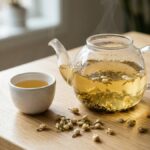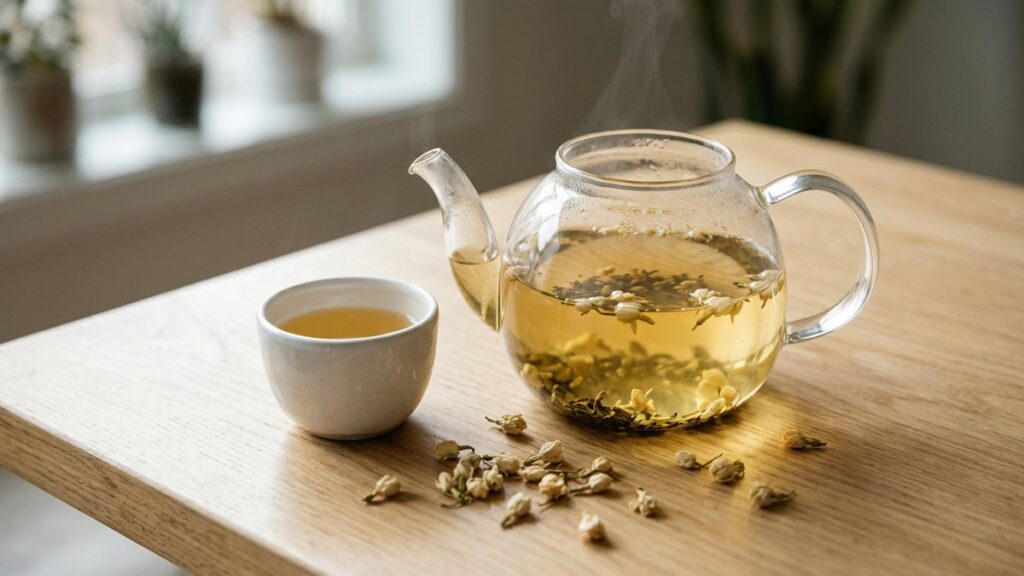
Jasmine tea benefits come mainly from the tea leaves it is made from, not from the jasmine blossoms. Most jasmine tea is green tea, so you get the same catechins and caffeine that green tea research has studied, plus a floral scent that may help some people feel calmer. The evidence supports jasmine tea as a pleasant, nearly calorie-free drink, but not as a weight-loss tool or a way to prevent disease.
Key takeaways
- Jasmine tea is usually green tea scented with jasmine flowers, so its health effects mostly follow green tea research.
- Green tea’s catechins and caffeine may have a modest effect on body weight, but a Cochrane review found the weight loss too small to matter clinically.
- An 8-ounce cup of green tea has about 28 mg of caffeine on average, less than a third of a cup of brewed coffee, based on USDA data.
- The jasmine scent lowered heart rate and lifted mood in a small lab study, but that study tested smelling the tea, not drinking it.
- Keep caffeine under 200 mg a day in pregnancy, drink tea between meals if your iron is low, and be wary of concentrated green tea extracts.
What is jasmine tea?
Jasmine tea is not a separate plant. Green, black and oolong teas all come from the same plant, Camellia sinensis, and differ in how the leaves are processed, according to the National Center for Complementary and Integrative Health (NCCIH).
Jasmine tea is made from green tea scented with jasmine flowers and is usually classified as green tea, as National Cancer Institute researchers explain in a large study of jasmine tea and cancer in China.
That detail matters. The tea leaves supply the caffeine and the plant compounds called catechins, while the flowers mainly add scent. So jasmine tea’s likely benefits are, for the most part, green tea’s benefits.
Three label checks help you know what you are buying:
- The base tea. Many products say “jasmine green tea.” If you see a jasmine blend made with black or oolong tea, expect more caffeine.
- The scent source. The ingredient list shows whether the tea was scented with jasmine flowers or simply flavored.
- Flowers only. A “jasmine herbal tea” made from blossoms with no tea leaves is a different drink. It lacks green tea’s catechins and the caffeine that comes from tea leaves.
Jasmine tea benefits: what the evidence supports
Most claims online mix strong evidence, borrowed green tea evidence and early lab findings. Here is how they stack up.
| Claim | What the research shows | Verdict |
|---|---|---|
| A good swap for sugary drinks | Plain brewed tea has essentially no calories | Supported |
| Helps you lose weight | Green tea preparations produced small, statistically non-significant weight loss in human trials; we found no human trials of jasmine tea itself | Weak |
| Lowers cholesterol | Green tea lowered total and LDL cholesterol slightly, mostly in studies of extract supplements | Modest |
| Protects the heart | Green tea is linked to lower heart disease risk in Asian but not Western populations | Uncertain |
| Prevents cancer | A large study in China found no protective effect of jasmine tea against esophageal or stomach cancer | Not shown |
| Helps you relax | Jasmine tea scent lowered heart rate in 24 volunteers during a 5-minute test | Early and small |
| Sharpens focus | L-theanine plus caffeine, both found in tea leaves, gave small, uncertain short-term gains in attention and mood in trials that mostly used measured doses, not brewed tea | Plausible but uncertain |
| Antioxidant, blood sugar and antibacterial effects | Based mainly on laboratory and animal research; we found no large human trials of jasmine tea for these outcomes | Speculative |
Supported: an easy, nearly calorie-free drink
Plain jasmine tea has essentially no calories, so it can replace soda, sweet tea or juice without adding sugar. That swap is the most dependable way tea helps with weight control.
Bottled jasmine teas are a different story, because some are sweetened. Check the Nutrition Facts label for added sugars before you buy.
Likely, from green tea research: catechins and caffeine
Green tea contains catechins and caffeine. NCCIH says these may have a modest effect on body weight, though the effect can vary with the product and how active a person is. In trials, green tea also reduced total and LDL (“bad”) cholesterol to a small extent, but most of those studies used extract supplements rather than brewed tea.
For heart health, drinking green tea has been linked to a lower risk of coronary heart disease in Asian populations but not in Western populations. Overall, NCCIH says definite conclusions cannot yet be reached about whether green tea helps with most of the uses it is promoted for.
Not shown: cancer prevention
The National Cancer Institute-led study compared 1,514 cases of esophageal and stomach cancer in China with 1,514 matched people without cancer. Drinking jasmine tea was not linked to a lower risk of any of the three cancers studied, and the authors found no evidence of a protective effect.
In men, heavier lifetime drinking was linked to a higher risk of one type of esophageal cancer, and the authors called for more research on tea temperature and quality. NCCIH likewise describes green tea and cancer research as inconsistent.
Promising but unproven: the calming scent
The jasmine itself has a small body of research. In a Japanese lab study of 24 healthy volunteers, five minutes of smelling a faint jasmine tea aroma lowered heart rate and shifted nervous system activity toward a calmer state.
Participants also reported calmer and more vigorous moods. Linalool, one of the scent’s main compounds, produced similar effects on its own.
That is interesting, but the study tested smelling, not drinking, in a small group for a few minutes. It does not show that jasmine tea treats anxiety or stress. Still, if a warm, fragrant cup helps you slow down, that ritual can be one piece of a broader plan for managing stress while you lose weight.
Plausible: a short-term lift in focus
Tea leaves also contain L-theanine. A 2025 meta-analysis of randomized trials found small to moderate gains in attention and mood in the first 2 hours after people took L-theanine plus caffeine, but the results were uncertain. Most trials used measured doses rather than brewed tea, and two of the authors work for tea companies.
Speculative: animal and lab findings
Many bolder claims, such as blood sugar control, immune support or fat loss from jasmine tea itself, trace back to animal or test-tube work. Results like these are reasons to study jasmine tea in people, not proof that it works in people. We found no large human trials showing that jasmine tea prevents diabetes, boosts immunity or treats depression.
Is jasmine tea good for weight loss?
Jasmine tea can support weight loss as a calorie-free drink, but it will not cause meaningful weight loss on its own. The best human evidence is a Cochrane review of green tea for weight loss in adults with overweight or obesity.
In six trials outside Japan, lasting about 12 weeks, the average difference in weight loss between green tea and control groups was 0.04 kg, essentially zero. Trials in Japan showed differences from 0.2 to 3.5 kg in favor of green tea, but they were too different from one another to combine.
The reviewers concluded that green tea preparations led to a small, statistically non-significant weight loss that is not likely to be clinically important. Those trials tested green tea preparations, not a casual cup of jasmine tea, and still found little effect.
What actually helps:
- Swap, don’t add. Use unsweetened jasmine tea in place of sugary drinks.
- Skip “fat-burning” pills. Liver injury, though uncommon, has been reported mostly with green tea extract tablets and capsules, according to NCCIH. Our guide to green tea extract for weight loss covers the risks in detail.
- Pair tea with habits that work. A sensible calorie target, filling meals and regular activity matter far more than any tea. For other teas people try, see our guide to metabolism-boosting teas and what the science says.
Jasmine tea caffeine: how it compares
Jasmine tea’s caffeine depends on its base tea. Jasmine flowers add scent, not caffeine, so jasmine green tea should land close to plain green tea.
| Drink (8 fl oz, brewed) | Average caffeine |
|---|---|
| Coffee | About 95 mg |
| Black tea | About 47 mg |
| Oolong tea | About 38 mg |
| Green tea, including jasmine green tea | About 28 mg |
| Decaffeinated green tea | 0 mg |
| Jasmine herbal tea (flowers only) | No tea leaves, so no tea caffeine |
We calculated these figures for an 8-ounce (237-gram) cup from USDA FoodData Central averages per 100 grams of brewed coffee and tea. The jasmine green tea figure is an estimate based on its base tea.
Real cups vary with the leaves, the amount you use and how you brew. MedlinePlus puts a 16-ounce cup of black or green tea at 60 to 100 mg of caffeine.
For most adults, MedlinePlus describes about 400 mg of caffeine a day, roughly four 8-ounce cups of brewed coffee, as a moderate amount. At USDA’s average for green tea, that would take about 14 cups.
If caffeine affects your sleep, keep tea to earlier in the day. Short sleep can make weight loss harder, as our guide to sleep and weight loss explains.
How to brew jasmine tea
- Heat the water gently. For jasmine green tea, heat water until it steams but does not boil, around 175 to 185°F (80 to 85°C).
- Measure. Use about 1 teaspoon of loose tea, or 1 tea bag, per 8 ounces of water.
- Steep briefly. Start with 2 to 3 minutes and taste. Over-steeped green tea turns bitter.
- Remove the leaves. Take out the bag or strain the leaves so the cup does not keep getting stronger.
- Let it cool a little. Very hot tea is worth avoiding, as the safety section below explains.
- Keep it plain. Add lemon or mint for flavor. If you sweeten it, measure the sugar or honey so it doesn’t quietly add up.
For iced jasmine tea, brew it at double strength and pour it over ice.
Jasmine tea side effects and who should limit it
Brewed tea is safe for most adults. NCCIH reports no safety concerns for green tea as a beverage in adults, apart from its caffeine. A few groups should take more care.
- Pregnancy and breastfeeding. MedlinePlus advises keeping caffeine under 200 mg a day during pregnancy and says 1 or 2 small cups of coffee or tea a day is fine. Caffeine passes into breast milk, and high intake can make babies fussy and sleep poorly, according to NCCIH. Ask your prenatal care provider what is right for you.
- Low iron or anemia. Large amounts of tea make it harder for your body to absorb iron, so the NHS advises drinking less of it if you have iron deficiency anemia. A practical step is to drink tea between meals rather than with iron-rich foods or iron tablets.
- Caffeine sensitivity. MedlinePlus suggests limiting caffeine if you are prone to stress, anxiety or sleep problems. Choose decaf or flowers-only jasmine tea instead.
- Very hot drinks. In earlier studies reviewed by the National Cancer Institute team, drinking tea at high temperatures was repeatedly linked with esophageal cancer. Let your cup cool before you sip.
- Certain medicines. High doses of green tea can lower blood levels of the blood pressure drug nadolol. Green tea extract can lower levels of the cholesterol drug atorvastatin, and green tea has interacted with the osteoporosis drug raloxifene. If you take these or other prescription medicines, ask your pharmacist before drinking a lot of green tea or using extracts.
- Extract supplements. Pills are not the same as tea. NCCIH lists nausea, constipation, stomach discomfort and higher blood pressure as side effects of green tea extracts, along with rare liver injury. The FDA does not approve dietary supplements for safety or effectiveness before they are sold.
Looking for more evidence-based food and drink guides? Browse our healthy eating articles.
Frequently asked questions
Is it OK to drink jasmine tea every day?
Yes, for most healthy adults. A few cups a day stays well within the roughly 400 mg of caffeine MedlinePlus describes as moderate. Keep it unsweetened, and cut back if you are pregnant, low in iron or sensitive to caffeine.
Does jasmine tea have more caffeine than green tea?
Not when it is made with green tea, which most jasmine tea is. The jasmine adds no caffeine, so jasmine green tea has about the same amount as plain green tea, around 28 mg per 8 ounces on average. Blends made with black or oolong tea have more.
Does jasmine tea help you sleep?
Probably not, if it contains caffeine. Its scent had calming effects in a small study, but the caffeine in green tea can work against sleep. For an evening cup, choose decaf jasmine green tea or a caffeine-free jasmine herbal tea.
Can jasmine tea reduce belly fat?
No drink targets belly fat. Green tea preparations produced only small, clinically unimportant weight changes in a Cochrane review, and we found no human trials of jasmine tea itself for weight or belly fat. Losing belly fat comes from overall weight loss through eating habits and activity.
Is jasmine tea safe during pregnancy?
In moderation, it is for most people. Count it toward the under-200 mg daily caffeine limit MedlinePlus advises in pregnancy, along with coffee, soda and chocolate. Talk with your provider if you drink several cups a day.
Is jasmine tea healthier than plain green tea?
Because jasmine tea is usually green tea, the two are nearly the same nutritionally. The main difference is the aroma. Choose the one you enjoy enough to drink without sugar.
Sources
- National Center for Complementary and Integrative Health. Green Tea.
- Gao Y, et al. Jasmine tea consumption and upper gastrointestinal cancer in China. Cancer Causes and Control, 2009.
- Kuroda K, et al. Sedative effects of the jasmine tea odor and (R)-(-)-linalool, one of its major odor components, on autonomic nerve activity and mood states. European Journal of Applied Physiology, 2005.
- Payne ER, et al. Effects of Tea (Camellia sinensis) or its Bioactive Compounds l-Theanine or l-Theanine plus Caffeine on Cognition, Sleep, and Mood in Healthy Participants: A Systematic Review and Meta-Analysis of Randomized Controlled Trials. Nutrition Reviews, 2025.
- Jurgens TM, et al. Green tea for weight loss and weight maintenance in overweight or obese adults. Cochrane Database of Systematic Reviews, 2012.
- USDA FoodData Central, SR Legacy: brewed coffee (171890), black tea (173227), oolong tea (174120), green tea (171917) and decaffeinated green tea (171910).
- MedlinePlus (U.S. National Library of Medicine). Caffeine in the diet.
- NHS. Iron deficiency anaemia.