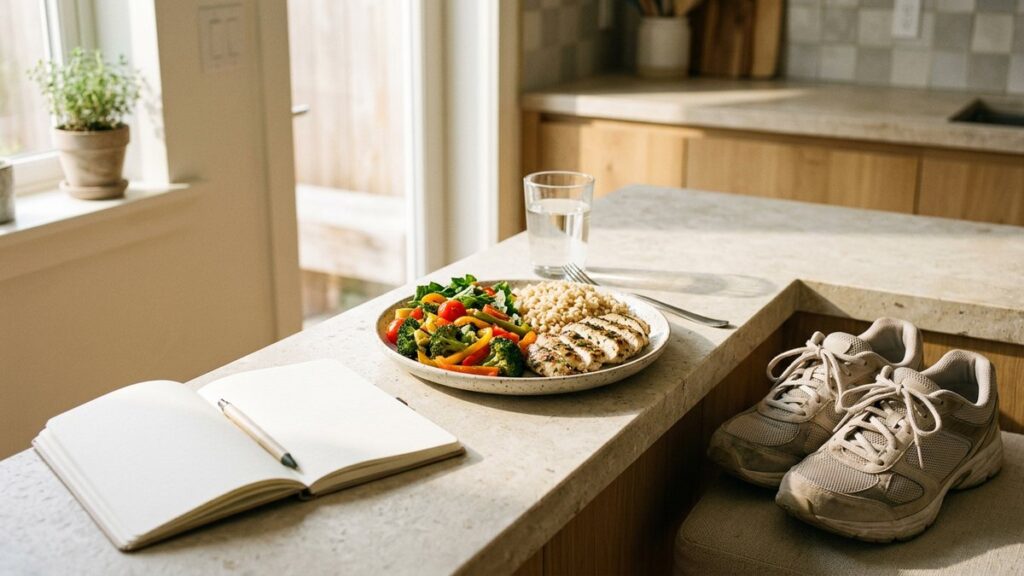
If you are wondering how to start losing weight, change one layer of habits at a time instead of overhauling your whole life at once. Spend week 1 tracking what you do now, week 2 fixing your plate, week 3 adding movement and week 4 protecting your sleep and managing stress. Aim for a steady loss of about 1 to 2 pounds a week, the pace the NHS recommends.
Key takeaways
- Set a realistic first goal: 5% to 10% of your starting weight within 6 months, or about 1 to 2 pounds a week.
- Use week 1 to track, not diet. Your baseline shows which changes will matter most for you.
- Build meals on a simple plate: half vegetables and fruit, a quarter whole grains and a quarter protein.
- Work up to 150 minutes of moderate activity a week plus strength training on 2 days, starting with short walks.
- Protect your sleep. In a small trial, dieters who slept 5.5 hours lost less fat and more lean mass than when they slept 8.5 hours.
First steps to lose weight safely: when to see a doctor
Most healthy adults can begin these changes on their own. The NHS advises seeing a doctor if your BMI is in the overweight or obesity range and you have a condition such as prediabetes, diabetes, high blood pressure, high cholesterol, sleep apnea or heart disease, or you have or think you may have an eating disorder. In short, check in with a doctor or other health care professional first if any of these apply to you:
- Your BMI is 30 or higher. That is the obesity range on the NHLBI BMI calculator. A clinician can check your blood pressure, blood sugar and cholesterol and discuss whether medical treatment could help alongside these habits.
- You have diabetes, especially if you use insulin or another medicine that can cause low blood sugar. Eating less can change how much medicine you need.
- You take daily prescription medicines. Some, including certain steroids, antidepressants and beta blockers, can make weight harder to manage, and doses for blood pressure or blood sugar may need adjusting as you lose weight.
- You are pregnant, trying to get pregnant or breastfeeding. These are not times to start a weight-loss plan without your provider’s guidance.
- You have a history of an eating disorder, or tracking food tends to make you anxious or obsessive. A clinician or registered dietitian can help you choose an approach that protects your recovery.
- You have heart, kidney or liver disease, or you get chest pain, dizziness or unusual shortness of breath when you are active.
Set a realistic goal
A good first target is 5% to 10% of your starting weight within 6 months. That is the initial goal experts recommend, according to the National Institute of Diabetes and Digestive and Kidney Diseases (NIDDK). For someone who weighs 200 pounds, it means losing 10 to 20 pounds.
Week to week, aim for about 1 to 2 pounds, the steady pace the NHS recommends. You do not need dramatic results to benefit: the NHS notes that losing just 5% to 10% of your body weight can improve your health.
Over your first 30 days, that pace works out to roughly 4 to 8 pounds. Your results may come faster or slower, so judge progress by your weekly average rather than any single morning.
How to set your calorie target
You do not have to count calories forever, but knowing roughly how much to eat makes the first month much easier. A simple, reliable tool is the free NIH Body Weight Planner:
- Enter your age, sex, height, weight and usual activity level.
- Enter a goal weight and a date, such as 5% lower in 6 months.
- If you like, add the extra activity you plan to start in week 3.
- Use the “reach your goal” calories as your daily target, and note the “maintain” number for later.
The planner warns that people often underestimate how much they eat, which is one more reason week 1 starts with tracking. For other ways to estimate your needs, see our guide to how many calories to eat to lose weight.
How to start losing weight: a 30-day plan for beginners
Each week adds one new focus while you keep the habits from the week before. Use the table as your checklist, then read the details for each week below.
| Week | Focus | Daily checklist | Move on when |
|---|---|---|---|
| Week 1 (days 1–7) | Track your baseline | Log everything you eat and drink. Note your steps and sleep. Weigh yourself on 2 or 3 mornings. | You have at least 5 days logged and know your top 3 sources of extra calories. |
| Week 2 (days 8–14) | Build a protein-and-fiber plate | Fill half your plate with vegetables and fruit. Add a protein and a whole grain. Drink water, coffee or tea instead of sugary drinks. | Most of your meals follow the plate on at least 5 days. |
| Week 3 (days 15–21) | Add movement | Walk 10 to 20 minutes most days. Do 2 short strength sessions this week. | You have logged about 75 minutes of activity, halfway to the 150-minute goal. |
| Week 4 (days 22–30) | Sleep and stress | Keep the same bedtime and wake time. Put screens away before bed. Use one daily stress outlet that is not food. | You keep regular sleep times on most nights and have a plan for stress eating. |
Week 1: Track your baseline (days 1–7)
Do not diet yet. This week you are collecting information. Write down everything you eat and drink, including cooking oil, sauces, coffee add-ins and bites eaten standing up. NIDDK lists daily monitoring of eating, drinking, sleep and activity, plus a weekly weight check, among the features of successful weight-loss programs.
Also note:
- Your weight on 2 or 3 mornings, after using the bathroom and before eating.
- Your daily steps, if your phone or watch counts them.
- Your hours of sleep and the times of day you feel hungriest.
Tracking is worth the effort. A systematic review of 22 studies consistently found a link between self-monitoring of diet, exercise or weight and greater weight loss, although the reviewers rated the evidence as weak because of study limitations. Most studies in that review used paper diaries, so an app is optional. Pick the method you will actually use.
At the end of the week, circle your top three sources of extra calories. Common ones include sugary drinks, large dinner portions, evening snacks, alcohol and restaurant meals. Those become your targets in week 2.
Week 2: Build a protein-and-fiber plate (days 8–14)
Now change what goes on your plate, not just how much. The Healthy Eating Plate from the Harvard T.H. Chan School of Public Health is an easy template:
- Half the plate: vegetables and fruit, in a variety of colors. Potatoes do not count as vegetables here.
- A quarter: whole grains such as brown rice, quinoa or whole-wheat pasta.
- A quarter: protein such as fish, poultry, beans or nuts. Limit red meat and avoid processed meats like bacon.
- On the side: healthy oils such as olive or canola oil for cooking and salads.
- To drink: water, coffee or tea with little or no sugar.
This plate puts fiber-rich foods (vegetables, fruit, beans and whole grains) and a protein at every meal. Start with breakfast, then lunch, then dinner. Our healthy breakfast ideas for weight loss follow the same pattern.
Then tackle the top three calorie sources you found in week 1, one every few days. Try sparkling water instead of soda, a smaller dinner plate, or fruit after dinner instead of a second helping.
Week 3: Add movement (days 15–21)
The Physical Activity Guidelines for Americans call for 150 to 300 minutes of moderate activity a week, like brisk walking, plus muscle-strengthening activity at least 2 days a week. You do not need to reach that in week 3. The guidelines also say any amount of activity has some health benefits, and short bouts throughout the day count.
A simple start is a 10- to 15-minute walk after one meal each day, adding a few minutes every couple of days. On 2 days, do a short strength routine at home: chair squats, wall push-ups and step-ups, 2 sets of each.
Keep expectations honest. NIDDK notes that more activity may not have a big impact on weight loss by itself, but it has important health benefits and may help you keep off the weight you lose. Walking is the easiest place to begin. Our guide on whether walking burns belly fat shows how to build up your walks.
Week 4: Protect sleep and manage stress (days 22–30)
Sleep is easy to overlook, but it matters. In a small randomized crossover trial, 10 adults with overweight followed the same reduced-calorie diet for 14 days, once with 8.5 hours in bed and once with 5.5 hours. With less sleep, the share of weight they lost as fat dropped by 55%, they lost more lean mass, and they felt hungrier.
This week:
- Set regular bed and wake times, and keep them close on weekends.
- Have your last caffeine earlier in the day, and put screens away before bed.
- Choose one daily stress outlet that is not food, such as a short walk, a call with a friend, stretching or writing tomorrow’s plan.
- Look for “stress eating” moments in your log and plan a different response for each one.
Among the questions NIDDK suggests asking about any weight-loss program is whether it will help you cope with stress, social eating and getting enough sleep. Those skills are part of the plan, not extras. Your thinking matters too. Our article on building a weight loss mindset covers the habits of people who succeed.
Weight loss tips for beginners: what to expect in month one
- The scale will bounce. Water, salt and meal timing shift your weight from day to day. Watch the trend across a week or two.
- Hunger may rise at first. Lean on vegetables, protein and regular meals rather than willpower alone.
- Some days will go off plan. A party or a hard week is information, not failure. Restart at your next meal.
- Non-scale wins count. More energy, looser clothes and easier walks often show up before big changes on the scale.
If the scale is not moving after 2 to 3 weeks
- Log everything again for 3 days. Portions, drinks and snacks tend to creep back.
- Compare what you are eating with your Body Weight Planner target.
- Cut one portion or snack a day, or add 10 minutes of walking.
- Check your sleep. Short nights make hunger harder to manage.
- If nothing changes after a month of steady effort, talk with your doctor. Medicines, thyroid problems and other conditions can affect weight.
After day 30: what comes next
Keep all four layers and repeat the cycle, choosing one area to improve each month. NIDDK says strategies that may help prevent weight regain include eating for your new weight, getting 150 to 300 minutes or more of activity per week and weighing yourself at least once a week. Your Body Weight Planner “maintain” number helps with the first of those once you reach your goal.
Ready for more? Our list of 15 tips for weight loss adds meal-prep and habit ideas for month two, and you will find more beginner guides in our weight loss tips section.
Frequently asked questions
Where do I start if I want to lose weight?
Track what you eat, drink, move and sleep for one week without changing much. That baseline shows which changes will matter most for you. If you have a health condition or take daily medicines, book a check-up as well.
How much weight can I lose in 30 days?
At the 1 to 2 pounds a week the NHS recommends, about 4 to 8 pounds is a realistic first month. NIDDK lists promises like “lose 30 pounds in 30 days” as a warning sign of programs to avoid.
Should I start with diet or exercise?
Start with food. NIDDK notes that activity alone may not have a big impact on weight loss, although it brings health benefits and helps you keep weight off. This plan adds movement in week 3, once your eating changes are underway.
Do I have to count calories to lose weight?
Not forever. A calorie target and a few weeks of tracking teach you what portions look like. After that, many people do well with the plate method and a weekly weigh-in.
Why haven’t I lost weight in my first week?
In this plan, week 1 is for tracking, so little change is expected. Even later, day-to-day swings in water weight can hide fat loss for a week or two. Look at your trend over 2 to 3 weeks before changing course.
Is walking enough to start losing weight?
Walking is a great start, especially when you pair it with changes to what you eat. Over time, work up to 150 to 300 minutes of moderate activity a week and add strength training on 2 days, as the activity guidelines recommend.
Sources
- NHS. Overweight and obesity in adults.
- National Institute of Diabetes and Digestive and Kidney Diseases. Choosing a Safe and Successful Weight-loss Program.
- National Institute of Diabetes and Digestive and Kidney Diseases. Body Weight Planner.
- National Heart, Lung, and Blood Institute. Calculate Your BMI.
- Office of Disease Prevention and Health Promotion. Top 10 Things to Know About the Second Edition of the Physical Activity Guidelines for Americans.
- Harvard T.H. Chan School of Public Health, The Nutrition Source. Healthy Eating Plate.
- Burke LE, Wang J, Sevick MA. Self-monitoring in weight loss: a systematic review of the literature. Journal of the American Dietetic Association, 2011.
- Nedeltcheva AV, et al. Insufficient sleep undermines dietary efforts to reduce adiposity. Annals of Internal Medicine, 2010.