What to eat on Ozempic, Wegovy or Zepbound comes down to a few rules: put protein first, eat small meals at regular times, add fiber slowly, drink enough fluids and go easy on greasy, fried and very sugary foods and alcohol. That approach comes from a 2025 joint advisory by four obesity and nutrition societies and from the drugs’ FDA labels. There is no official “Ozempic diet”; the aim is to protect muscle, ease side effects and cover your nutrient needs while you eat much less.
Key takeaways
- GLP-1 medicines cut how much people eat by about 16% to 39%, so food quality matters more than ever.
- Get enough protein. The joint advisory offers 80 to 120 grams a day as a practical target for many adults, paired with strength training.
- Small, regular meals and fewer high-fat foods ease nausea. For constipation, add fluids and fiber gradually.
- On Wegovy tablets, take the pill on an empty stomach with up to 4 ounces of plain water and wait at least 30 minutes before eating, drinking or taking other pills. The shots have no food-timing rule.
- Severe stomach pain that will not go away, vomiting or diarrhea that keeps going, or signs of gallbladder trouble need prompt medical care. If you also take insulin or a sulfonylurea, ask your care team about your dose as your appetite drops.
Why food choices matter more on a GLP-1
Ozempic is semaglutide approved for type 2 diabetes. Wegovy is semaglutide, given as a weekly shot or a daily tablet, approved for weight management and, in adults with heart disease, to lower the risk of heart attack and stroke. Zepbound is tirzepatide approved for weight management and sleep apnea.
All three slow stomach emptying and turn down appetite. According to the 2025 joint advisory on nutrition for GLP-1 therapy, people on these drugs eat about 16% to 39% fewer calories. That helps weight loss, but it also makes it easier to fall short on nutrients.
The advisory flags a risk of low intake of iron, calcium, magnesium, zinc and vitamins A, D, E, K, B1, B12 and C. The risk is greatest when women eat under about 1,200 calories a day or men eat under about 1,800. Signs of a real deficiency include unusual fatigue, heavy hair loss, flaky or itchy skin, muscle weakness, slow wound healing and easy bruising.
The same eating approach makes sense for other drugs in this class, such as Trulicity (dulaglutide). For an overview of the medicines themselves, see our guide to FDA-approved prescription weight loss medications.
What to eat on Ozempic: the core rules
- Eat your protein first. Start each meal with the protein part, so you get it in before you feel full.
- Fill the rest with plants. Choose vegetables, fruit, beans, lentils, whole grains, nuts and seeds.
- Eat small meals at regular times. Long gaps can worsen nausea and set up a rebound toward sweets and refined carbs.
- Drink fluids through the day. Vomiting or diarrhea can dehydrate you, and dehydration strains the kidneys.
- Limit the foods that cause trouble. Cut back on fried and greasy foods, sugary drinks, refined carbs, red and processed meats, most fast food and alcohol.
- Lift something. Fast weight loss can cost muscle and bone. Protein plus strength training is the main defense, and protein alone is not enough.
If you take Wegovy tablets
The tablet form of Wegovy is the one medicine in this guide with a food-timing rule. According to the Wegovy label, take the tablet each morning on an empty stomach with up to 4 ounces of plain water, and swallow it whole. Wait at least 30 minutes before you eat, drink anything else or take other pills.
Do not take it with coffee, juice or any liquid other than water. The weekly injections of Ozempic, Wegovy and Zepbound have no food-timing rule and can be taken with or without meals.
If you take Ozempic for type 2 diabetes
The same rules apply, but watch your carbs, because they raise blood glucose. The NIDDK plate method is a simple guide: fill half your plate with nonstarchy vegetables, a quarter with protein and a quarter with high-fiber carbs such as brown rice, whole grains, beans or fruit.
If you also take insulin or a sulfonylurea, skipping or delaying meals can drop your blood sugar too low. The Ozempic label tells prescribers to consider lowering those doses when Ozempic starts, so ask your care team how to adjust as your appetite drops.
Protein on Ozempic: how much and where to get it
The adult recommended dietary allowance is 0.8 grams of protein per kilogram of body weight a day. The joint advisory notes that higher targets, such as 1.2 to 1.6 g/kg, have been proposed during active weight loss.
For people with obesity, though, using actual body weight can overestimate needs. So the advisory offers a simpler option: an absolute target of 80 to 120 grams a day for many adults.
It also sets guardrails. Protein should not fall below about 0.4 to 0.5 g/kg a day, which can cause muscle loss, and long-term intake at or above 2 g/kg should be avoided. If you have kidney disease or a history of kidney stones, ask your clinician for a personal target.
When your appetite is small, choose protein that does not take up much room:
- Fish and seafood, eggs and skinless poultry
- Greek yogurt, cottage cheese and milk
- Beans, lentils, peas, tofu and edamame
- Nuts, seeds and nut butters, in small portions
- Protein shakes or fortified foods, if you cannot meet your target with meals
Keep red and processed meats to a minimum. For more ideas, see our list of low-calorie, high-protein foods and our guide to protein intake for fat loss.
Foods to eat more of and foods to avoid on Ozempic
This table follows the joint advisory’s food recommendations. Nothing is strictly banned, but the right-hand column lists foods most likely to cause side effects or crowd out nutrients.
| Food group | Eat more | Limit |
|---|---|---|
| Protein | Fish, seafood, eggs, poultry, Greek yogurt, cottage cheese, tofu, beans, lentils | Red meat, processed meats such as bacon, sausage and deli meats, fried meats |
| Vegetables and fruit | Broccoli, leafy greens, carrots, squash, peas, berries, apples, bananas | Large raw salads and other very high-fiber meals in the first few days of treatment, if you feel queasy |
| Grains | Oats, quinoa, brown rice, whole-grain bread and pasta | White bread, pastries, sugary cereals, refined flours |
| Fats | Olive, canola and avocado oils, nuts, seeds, avocado | Fried foods, greasy fast food, large high-fat meals |
| Drinks | Water, ginger tea, peppermint tea (unless it triggers heartburn), unsweetened milk | Sugar-sweetened drinks, alcohol |
| Snacks and sweets | Yogurt with fruit, a small handful of nuts, hummus with vegetables | Sweets, chips and other ultra-processed snacks. A planned, portion-controlled treat is fine. |
What to eat on Ozempic to avoid nausea
Nausea is the most common digestive side effect. It is most likely when you start the drug or raise the dose, and it often hits in the morning or after long stretches without food. The joint advisory recommends these steps:
- Eat a small breakfast (on Wegovy tablets, at least 30 minutes after the pill), then a small meal or snack every 3 to 4 hours.
- Stop at the first sign of fullness. Vomiting is more likely after large meals.
- Go lower in fat and fiber for the first few days of treatment. Soups, smoothies made with yogurt or milk, protein drinks and cottage cheese often go down easier than red meat, cold cuts or hard cheese.
- Do not skip meals because you feel queasy. Not eating can make nausea worse, which leads to eating even less.
- Try ginger or peppermint tea. Mint can trigger heartburn in some people, so choose ginger if you have reflux.
If nausea lasts, call your prescriber. Options include staying at your current dose longer or using anti-nausea medicine.
Heartburn, reflux and burping
Reflux and burping are listed among the common side effects in the Wegovy and Zepbound labels. The NIDDK suggests finishing meals at least 3 hours before you lie down or go to bed.
Common triggers include high-fat foods, spicy foods, chocolate, coffee and other caffeine, alcohol, mint, citrus fruit and tomatoes. The joint advisory adds that alcohol can worsen both nausea and reflux on GLP-1 therapy, so keep it to a minimum.
Constipation on Ozempic: what to eat and what else helps
Constipation is common with these drugs and with weight loss in general. Deal with it early, because constipation that drags on can also trigger bouts of diarrhea.
- Add fiber slowly. The NIDDK says adults need 22 to 34 grams of fiber a day, depending on age and sex, and should add it a little at a time. Good sources include oatmeal, whole grains, lentils, black beans, chickpeas, berries, pears, broccoli and almonds.
- Drink with your fiber. Water and other liquids help fiber work.
- Try prunes or other dried fruit. The joint advisory lists them as a helpful source of soluble and insoluble fiber. Watery fruits and vegetables can also help.
- Go easy on very fatty meals. Foods high in fat or protein slow stomach emptying further. Keep your protein, but you may need to cut back on rich, high-fat foods until things move again.
- Ask before using products. If food changes are not enough, the advisory lists daily magnesium (such as magnesium citrate), fiber supplements, polyethylene glycol 3350 and stool softeners. Check with your clinician first, especially if you have kidney disease.
Diarrhea can happen too. Avoiding large or high-fat meals helps, and fiber supplements can firm up stool.
A one-day GLP-1 diet plan with protein grams
This day spreads about 109 grams of protein across six small eating times. That sits inside the advisory’s 80 to 120 gram range.
Protein values come from USDA FoodData Central and count only the listed foods. Vegetables add a little more.
| Time | What to eat | Protein |
|---|---|---|
| Breakfast | 3/4 cup (170 g) plain nonfat Greek yogurt with 1/4 cup rolled oats and 1/2 cup raspberries, mixed the night before (on Wegovy tablets, at least 30 minutes after the pill) | 21 g |
| Mid-morning | 1 large hard-boiled egg | 6 g |
| Lunch | 3 oz canned light tuna (in water) over greens with 1/2 cup cooked lentils, olive oil and lemon | 31 g |
| Afternoon | 1/2 cup 1% cottage cheese with 3 prunes | 15 g |
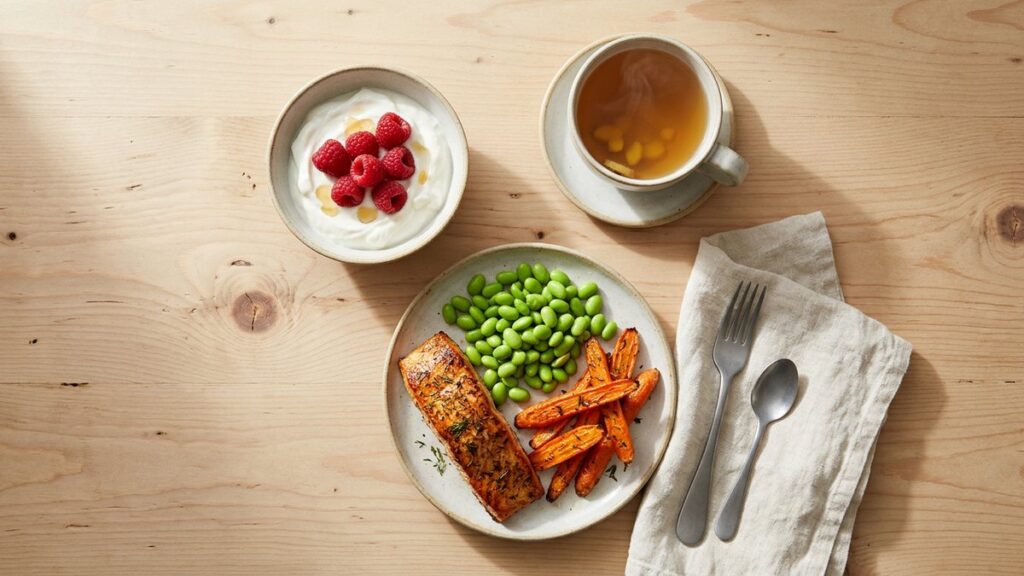
| Dinner | 3 oz baked farmed salmon, 1/2 cup shelled edamame, roasted carrots | 28 g |
| Evening, if hungry | 1 cup 1% milk | 8 g |
| Total | about 109 g |
The listed foods also give about 20 grams of fiber, with more from the greens and carrots.
A smoothie made with Greek yogurt or milk can stand in for a meal. If you have reflux, skip the lemon and eat dinner at least 3 hours before bed.
Do you need supplements on a GLP-1?
Maybe. The joint advisory says clinicians can consider vitamin D, calcium, vitamin B12 or a multivitamin-mineral for people at risk, tailored to each person. It also recommends checking nutrient levels during treatment when needed.
Ask your prescriber or a registered dietitian before you start anything. The FDA does not approve dietary supplements for safety or effectiveness before they are sold.
Side effects that need a doctor
Call your prescriber or get urgent care if you have any of these. The warnings come from the FDA labels for Ozempic, Wegovy and Zepbound.
- Severe stomach pain that will not go away, sometimes spreading to your back, with or without vomiting. This can be a sign of pancreatitis.
- Pain in your upper stomach, fever, yellowing of your skin or eyes, or clay-colored stools. These can be signs of gallbladder problems.
- Vomiting or diarrhea that keeps going, or being unable to keep fluids down. Dehydration can lead to kidney injury.
- Shakiness, sweating or dizziness if you also take insulin or a sulfonylurea. Low blood sugar is more likely with these combinations.
- Swelling of the face, lips, tongue or throat, trouble breathing or swallowing, or fainting. Get emergency care for a possible allergic reaction.
A few other cautions apply:
- Surgery and sedation. Tell every doctor, dentist and anesthesia team that you take a GLP-1 before any procedure with sedation. Food can stay in the stomach longer and could be inhaled into the lungs (pulmonary aspiration).
- Pregnancy. The Wegovy and Zepbound labels warn they may harm a developing baby and should be stopped once pregnancy is confirmed. The Ozempic and Wegovy labels advise stopping at least 2 months before a planned pregnancy.
- Birth control pills. The Zepbound label says it can make birth control pills less effective. Use a non-oral method, or add a barrier method, for 4 weeks after starting and after each dose increase.
- Eating disorders. If you have a history of an eating disorder, the joint advisory recommends seeing an obesity medicine specialist and an eating disorder specialist first. It calls a restrictive eating disorder a general reason not to use these drugs.
Build habits now that will outlast the prescription
The joint advisory notes that most people prescribed GLP-1s for obesity stop within a year. The reasons are not well measured, but side effects, cost and insurance coverage play a part.
When the drugs are stopped, people often regain up to two-thirds of the lost weight within a year, even with standard diet counseling.
Habits you build while on the drug, such as protein at every meal, regular meal times, minimally processed food and strength training, give you the best chance of limiting regain if you stop, though studies have not yet shown how much they help. Find more meal ideas in our healthy eating section.
Frequently asked questions
What foods should you avoid on Ozempic?
No food is strictly off-limits, but greasy and fried foods, large high-fat meals, sugary drinks, sweets, refined carbs, processed meats and alcohol are the most likely to worsen nausea, reflux or diarrhea. They also crowd out the protein and nutrients you need. Spicy foods can trigger heartburn as well.
How many calories should I eat on Ozempic?
There is no set number. The joint advisory warns that nutrient shortfalls become more likely below about 1,200 calories a day for women or 1,800 for men. Ask your prescriber or a registered dietitian for a personal target, and focus on protein and nutrient-dense foods first.
What should I eat on Ozempic if I’m not hungry?
Eat small amounts on a schedule instead of waiting for hunger. Start with protein, such as Greek yogurt, eggs, cottage cheese or a protein shake, and set a reminder to eat every 3 to 4 hours. Long gaps can worsen nausea and leave you short on nutrients.
Can you eat carbs on Ozempic?
Yes. Choose high-fiber carbs such as oats, brown rice, beans, lentils and fruit, and limit refined carbs and sugary drinks, which the joint advisory flags. If you have type 2 diabetes, use the plate method or the carb plan your care team gives you, and ask about your insulin or sulfonylurea dose if you are eating much less.
Can you drink alcohol on Ozempic?
Small amounts are not forbidden on the labels, but the joint advisory says alcohol can worsen nausea and reflux and recommends keeping it to a minimum. Alcohol also adds calories without protein or fiber. Talk with your prescriber about what is safe for you.
What helps constipation on Ozempic?
Drink more fluids, add fiber gradually toward 22 to 34 grams a day and eat prunes or other high-fiber fruit. If that is not enough, ask your clinician about magnesium, fiber supplements or polyethylene glycol 3350. Call promptly if constipation comes with severe pain or vomiting.
Sources
- Mozaffarian D, et al. Nutritional priorities to support GLP-1 therapy for obesity: a joint advisory from the American College of Lifestyle Medicine, the American Society for Nutrition, the Obesity Medicine Association and The Obesity Society. Obesity, 2025.
- U.S. National Library of Medicine, DailyMed. Ozempic (semaglutide) injection prescribing information.
- U.S. National Library of Medicine, DailyMed. Wegovy (semaglutide) injection and tablets prescribing information and Medication Guide.
- U.S. National Library of Medicine, DailyMed. Zepbound (tirzepatide) prescribing information.
- National Institute of Diabetes and Digestive and Kidney Diseases. Eating, diet and nutrition for constipation.
- National Institute of Diabetes and Digestive and Kidney Diseases. Eating, diet and nutrition for GER and GERD.
- U.S. Department of Agriculture. FoodData Central (SR Legacy nutrient values). FDC IDs: light tuna, canned in water, 171986; lentils, cooked, 172421; Atlantic salmon, farmed, cooked, 175168; edamame, frozen, prepared, 168411; cottage cheese, 1% milkfat, 173417.
- National Institute of Diabetes and Digestive and Kidney Diseases. Healthy living with diabetes.